What is Latin American? Literary perspectives for reflecting on our identity

We published with Dr. Iram Evangelista, Dr. Erbey Mendoza Negrete and myself, an analysis of six Latin American identity traits from the perspective of four contemporary writers.


Abstract: This article presents certain Latin American traits from the works of four prestigious and contemporary Latin American writers: Gioconda Belli, Gonzalo Rojas, Augusto Monterroso y Juan José Arreola. The traits discussed include politics, the religious cult, the messianic vision, family, couples and the father figure. We argue that it is very important for people to understand their own culture and identity, to explore and not abandon the conversations about their countries’ literary works, as they reflect, report and critique them.

Full text available at Sage Publications

Recomended reference: Evangelista-Ávila, I. I., Mendoza, E., & Machin-Mastromatteo, J. D. (2019). What is Latin American? Literary perspectives for reflecting on our identity. Information Development, 35(2), 342–346. https://doi.org/10.1177/0266666919828979

Users’ Voice for Public Libraries Strategic Planning Using Quality Function Deployment (QFD)

Abstract: Given that strategic planning has traditionally worked by listening only to the voice of managers, in addition to studying their environments and functional processes, this initiative considers it fundamental to listen to the voice of the user, considering that they are the ones who truly face the conditions of the quality of library services. Therefore, the results of a user study are taken as a reference, where the Quality Function Deployment (QFD) tool was applied in public libraries in the municipality of Chihuahua, Mexico, which allowed identifying that the planning Strategic of libraries in an integral administrative system, can be sustained in the management of the quality and in the table of indicators of performance, whose implantation could be developed undera cycle of design, control, improvement and innovation to reach harmonic and systematic objectives.

Full text at Bibliotecas

Recomended reference: Romo-González, J., Tarango, J., & Machin-Mastromatteo, J. (2018). La voz del usuario en la planeación estratégica de bibliotecas públicas usando el Despliegue de la Función de la Calidad (QFD). Bibliotecas, 36(2), 1-29. https://doi.org/10.15359/rb.36-2.3

Interview: Scientific journals, publication, production and teaching

Live at Radio Universidad’s Tips, Talks and Topics show, January 11, 2019.


List of authors UACH 2018

According to Scopus, I am the academic with most publications for the fourth year in a row in the institution I work in (previous and current employment). Second year in a row at UACH. According to Web of Science I was number 2 in 2018.


#2018Results

Accreditation Council for Educational Programs on the Humanities (COAPEHUM)

From 27th to 30th November I was incorporated as an evaluator for the Accreditation Council for Educational Programs on the Humanities (COAPEHUM), as I conducted the evaluation of the Librarianship and Information Studies bachelor’s program at Universidad Nacional Autónoma de México.


This slideshow requires JavaScript.

Publons: Peer Review Week 2018

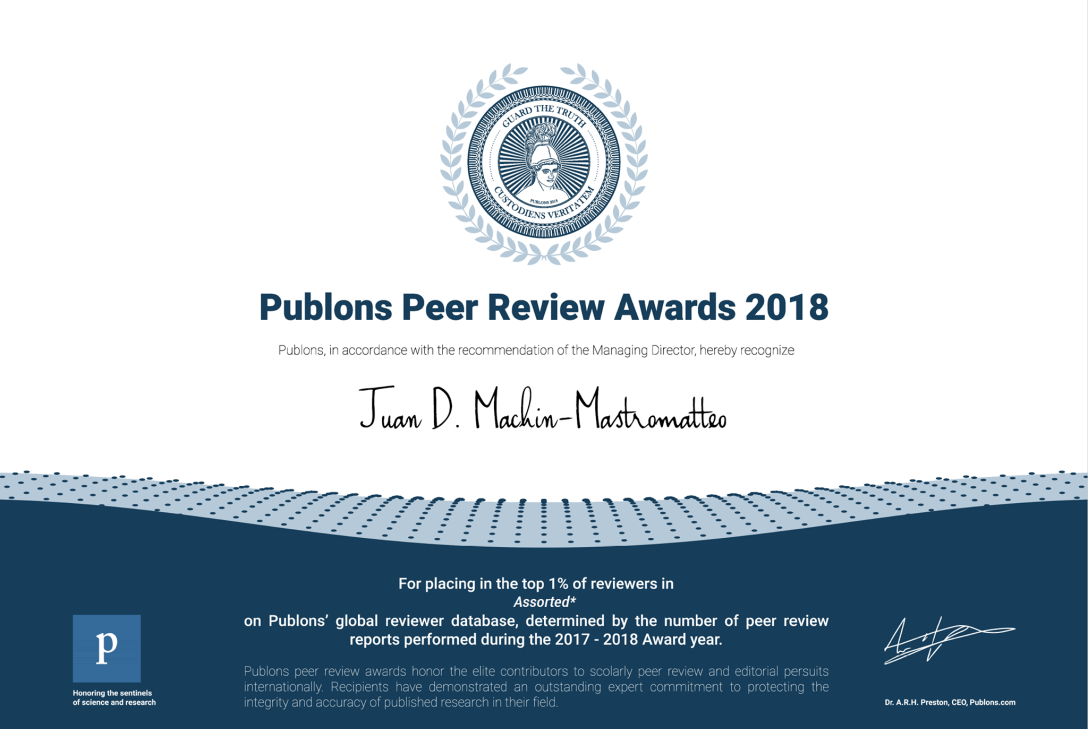
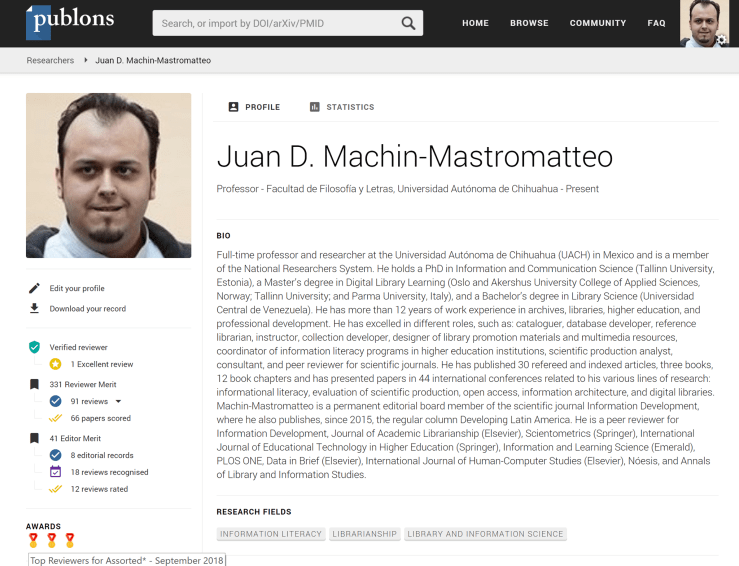
Within #PeerReviewWeek18, for the third year in a row, Publons has awarded my peer review work in scientific journals, as I am positioned within the 1% top reviewers in the world within my fields.


41666363_2166268720309095_6522165223481147392_o41548465_2166268690309098_1261377932866093056_o

Check it out https://publons.com/author/704567/juan-d-machin-mastromatteo#profile

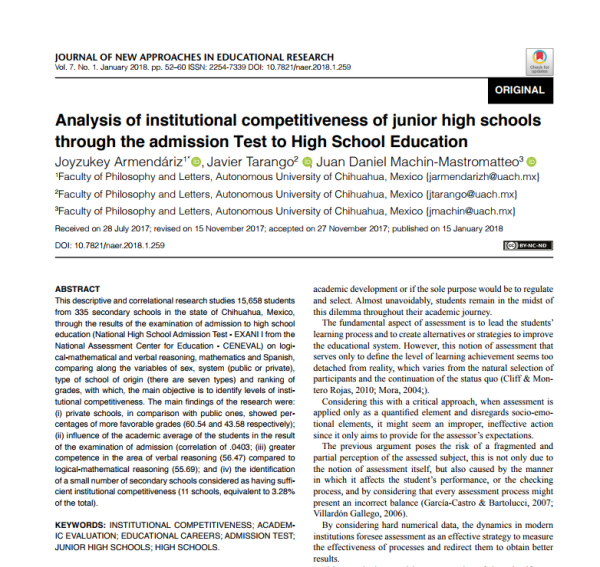
Analysis of Institutional Competitiveness of Junior High Schools through the Admission Test to High School Education


EN


Abstract: This descriptive and correlational research studies 15,658 students from 335 secondary schools in the state of Chihuahua, Mexico, through the results of the examination of admission to high school education (National High School Admission Test – EXANI I from the National Assessment Center for Education – CENEVAL) on logical-mathematical and verbal reasoning, mathematics and Spanish, comparing along the variables of sex, system (public or private), type of school of origin (there are seven types) and ranking of grades, with which, the main objective is to identify levels of institutional competitiveness. The main findings of the research were: (i) private schools, in comparison with public ones, showed percentages of more favorable grades (60.54 and 43.58 respectively); (ii) influence of the academic average of the students in the result of the examination of admission (correlation of .0403; (iii) greater competence in the area of ​​verbal reasoning (56.47) compared to logical-mathematical reasoning (55.69); and (iv) the identification of a small number of secondary schools considered as having sufficient institutional competitiveness (11 schools, equivalent to 3.28% of the total).

Full-text in Journal of New Approaches in Educational Research

This article was published in an Open Access journal!

Recommended reference: Armendáriz, J, Tarango, J., and Machin-Mastromatteo, J. D. (2018). Analysis of Institutional Competitiveness of Junior High Schools through the Admission Test to High School Education. Journal of New Approaches in Educational Research, 7 (1), 52-60. https://doi.org/10.7821/naer.2018.1.259


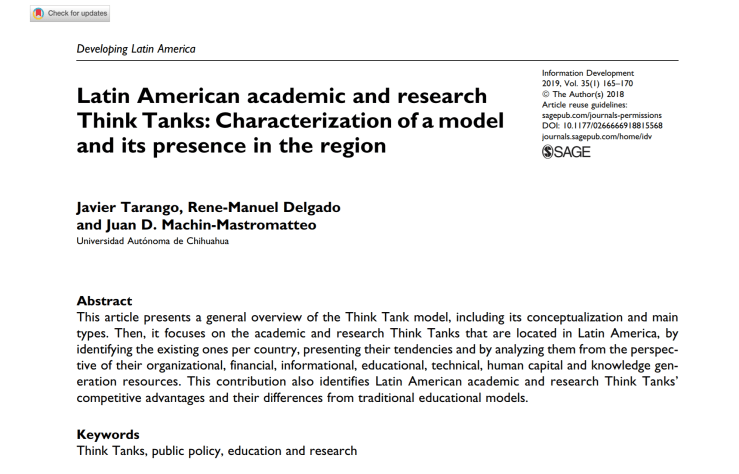
Latin American academic and research Think Tanks: Characterization of a model and its presence in the region

49897469_2235621060040527_5874750103914283008_o

Our second article of the year #WeAreOnFire, where we perform a regional diagnostic of the Latin American institutions that can be considered as academic and research think tanks.


Abstract: This article presents a general overview of the Think Tank model, including its conceptualization and main types. Then, it focuses on the academic and research Think Tanks that are located in Latin America, by identifying the existing ones per country, presenting their tendencies and by analyzing them from the perspective of their organizational, financial, informational, educational, technical, human capital and knowledge generation resources. This contribution also identifies Latin American academic and research Think Tanks’ competitive advantages and their differences from traditional educational models.

Full text at Sage Publications

Recomended reference: Tarango, J., Delgado, R., & Machin-Mastromatteo, J.D. (2019). Latin American academic and research Think Tanks: Characterization of a model and its presence in the region. Information Development, 35(1), 165–170.

Recovering troubled cities through public spaces and libraries: The Caracas Metropolitan Strategic Plan 2020


Sin título

Together with my fellow contryman, Renny Granda, public libraries’ own knight, we published the third part of the Caracas Trilogy (see first part and second part), where we invite you to reflect upon the question: could public spaces and libraries help us reducing violence in Latin American cities?


Abstract: The Caracas Metropolitan Strategic Plan 2020 (CMSP2020) is an instance of urban and environmental planning that seeks to construct a collective ‘city pact’ for Caracas, currently among the most troubled and violent cities in Latin America. Its main idea is to recover the city through the rescue of its public spaces, by centering on six strategic axes for transforming Caracas: accessibility and mobility; public safety, public spaces and housing improvement; environmental sustainability; productivity and entrepreneurship; governability; and the development of a constructive and responsible citizenship. This model, partly inspired by Medellin’s Library Parks, may be useful for other large cities in the region that suffer similar socio-political fractures, as well as accessibility, mobility, environmental, productive, governance and safety issues.

Full text at Sage Publishing

Open Access version (Coming soon!)

Recommended reference: Granda, R., and Machin-Mastromatteo, J. D. (2018). Recovering troubled cities through public spaces and libraries: The Caracas Metropolitan Strategic Plan 2020. Information Development, 34(1), 103–107. http://doi.org/10.1177/0266666917741069


Latin American triple-A journals 1: A quality roadmap from the quality indicators and journals’ presence in Web of Science and Scopus

The new Developing Latin America, co-authored with Javier Tarango and Eduardo Medina-Yllescas is out. In this issue, we analyze the current presence of Latin American journals in Web of Science and Scopus, as the first part of a quality roadmap intended to strengthen regional publications, especially those that have started as institutional publications. Dedicated to the loving memory of Cristobal Salvador Gómez Contreras (1992-2017).


Abstract: The current presence of Latin American journals in Web of Science and Scopus is analyzed, as the first part of a quality roadmap intended to strengthen regional publications, especially those that have started as institutional publications. The next issue will study the quality requirements and journals’ presence in other recognized indexes and platforms such as Scimago Journal and Country Rank, the Directory of Open Access Journals, Latindex, SciELO, and RedALyC.

Full text at Sage Publishing

Open Access version

Recommended reference: Machin-Mastromatteo, J. D., Tarango, J., and Medina-Yllescas, E. (2017). Latin American triple-A journals 1: A quality roadmap from the quality indicators and journals’ presence in Web of Science and Scopus. Information Development, 33(4), 436-441. http://dx.doi.org/10.1177/0266666917718138