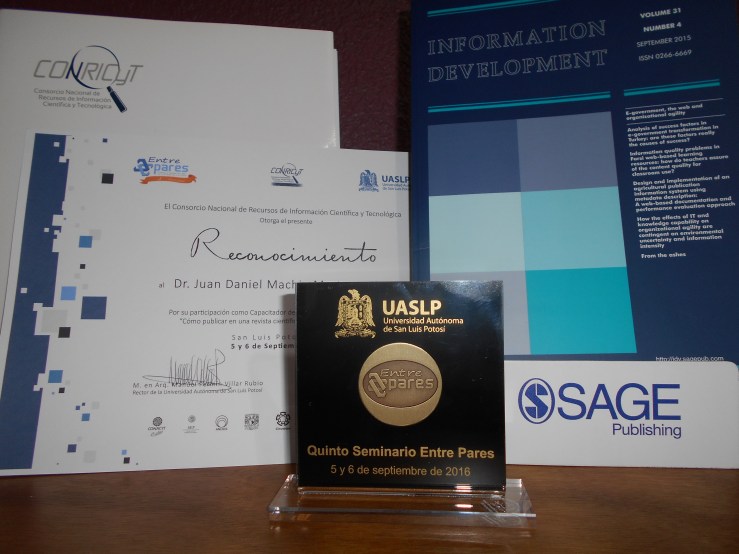
Very thankful with CONRICyT for having recorded and shared my #EntrePares presentation: How to publish in a scientific journal of the Social Sciences field
Inclusion of information literacy in the curriculum through learning communities and action research

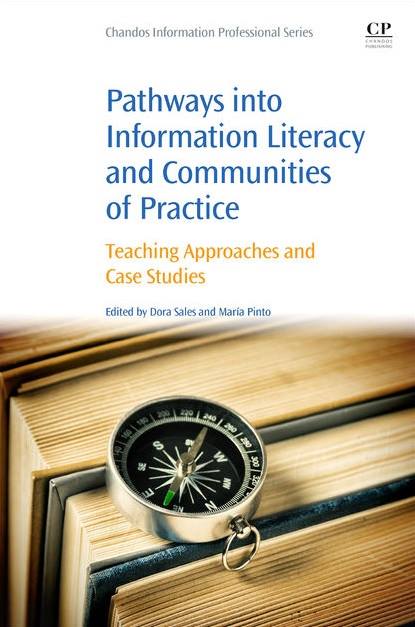
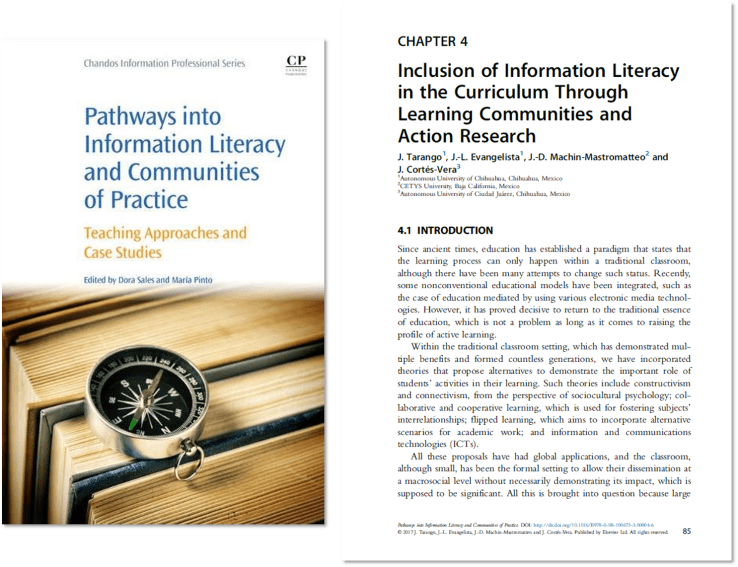
The book ‘Pathways into information literacy and communities of practice: Teaching approaches and case studies‘ is now available by Elsevier-Chandos. In it, you will find ‘Chapter 4 – Inclusion of information literacy in the curriculum through learning communities and action research‘, co-written with my dear colleagues Javier Tarango, José Luis Evangelista y Jesús Cortés. The whole book is highly recommended, edited by Dora Sales y María Pinto.
Abstract: This work corresponds to a practical and transversal integration process of information literacy in university curricula, specifically with undergraduate students from the philosophy program of the Autonomous University of Chihuahua (Mexico), by developing alternatives to evolve traditional classroom teaching practices toward integrating learning communities and using action research as means of influencing a continuous improvement upon learning processes. This chapter discusses basic concepts from this study and provides the results, which were a product of the data collected from ethnographic processes. This practical experience has demonstrated the feasibility of combining this study’s components for the achievement of active learning, but also for identifying specific elements that inhibit a full implementation. http://dx.doi.org/10.1016/B978-0-08-100673-3.00004-6
Certified Sentinel of Science, 2016 award by Publons.com
Publons, a website that created a system for recognizing the value of an activity rarely taken into consideration: peer review has awarded me with the title of Certified Sentinel of Science, for being among the top 10% of best reviewers in the Social Sciences field at a worldwide level. Have you performed peer-review activities? Try creating your profile at http://publons.com to get recognition for it, it’s well worth it! You can also have a look at my profile.
Piracy of scientific papers in Latin America: An analysis of Sci-Hub usage data

In the new issue of Developing Latin America: ‘Piracy of scientific papers in Latin America: An analysis of Sci-Hub usage data’, co-written with dear colleagues Alejandro Uribe-Tirado and María Elena Romero-Ortiz, we present Sci-Hub’s characteristics, a criticism to its perception as a de-facto component of the Open Access movement, its implications for information professionals, universities and libraries, and we replicate an analysis published in Science, but using only Latin America usage data. Ever wondered how many papers are illegally downloaded from Sci-Hub in the region? Find also the answer of how illegal downloads compare to legal downloads done through the Mexican and Argentinian scientific information consortia.
Acknowledgements: we wish to thank the InfoTecarios group for informing about regional challenges, specifically the help of Saúl Equihua, Myrna Lee and Renny Granda; and comments received from Dominique Babini, Paola Azrilevich, Alejandra Méndez, Luis Rojas, Nitida Carranza, Sonia Amaya, and Dr. Elsi Jiménez.
Abstract: Sci-Hub hosts pirated copies of 51 million scientific papers from commercial publishers. This article presents the site’s characteristics, it criticizes that it might be perceived as a de-facto component of the Open Access movement, it replicates an analysis published in Science using its available usage data, but limiting it to Latin America, and presents implications caused by this site for information professionals, universities and libraries.
Recommended reference: Machin-Mastromatteo, J.D., Uribe-Tirado, A., and Romero-Ortiz, M. E. (2016). Piracy of scientific papers in Latin America: An analysis of Sci-Hub usage data. Information Development, 32(5), 1806–1814. http://dx.doi.org/10.1177/0266666916671080
How to publish in a Social Sciences scientific journal #EntrePares2016


Four theories to improve justice in Latin America

In the new issue of Developing Latin America: ‘Four theories to improve justice in the region’, co-written with my good friend, the lawyer Basilio A. Martínez-Villa, we provide a very brief introduction to the theories of justice of John Rawls, Ronald Dworkin, Jürgen Habermas and Amartya Sen, as they bring forward the requirement for developing indicators with a wider scope, and we summarize relevant aspects of justice that can enrich the needed reflection and discussion for new Latin American models of justice.
Abstract: The theories of justice according to Rawls, Dworkin, Habermas and Sen, although from a predominantly Anglo-Saxon background, are useful for the Latin American reality. Such views of justice bring forward the requirement for developing indicators with a wider scope, so that they measure diverse aspects such as: income, commodities, freedoms, economic, cultural, educative, political and well-being factors. Concluding remarks summarize relevant aspects of justice that can enrich the needed reflection and discussion for new Latin American models of justice.
Full text at Sage Publications
Recommended reference: Martinez-Villa, B. A. and Machin-Mastromatteo, J. D. (2016). Four theories to improve justice in the region. Information Development, 32(4), 1284–1288. http://dx.doi.org/10.1177/0266666916658588
Announcement: Pathways into information literacy and communities of practice
The most “perfect” voting system in the world

In the new issue of Developing Latin America, I present the most common criticisms to e-voting systems, focusing on the Venezuelan case, with 15 elections during the last 17 years. This is the so-called most “perfect” voting system in the world. But it has been widely questioned, studied and contested.
Abstract: Elections are indispensable for democracy, but their trustworthiness demands transparency and impartiality from governments, even more so for automated elections. This work presents common criticisms to e-voting systems, focusing on the Venezuelan case, where there have been around 15 elections of this kind in the last 17 years. The Venezuelan government calls it the most perfect voting system in the world, but its results have been questioned, studied and contested.
Full text at Sage Publications
Recommended reference: Machin-Mastromatteo, J. D. (2015). The most “perfect” voting system in the world. Information Development, 32(3), 751-755. http://dx.doi.org/10.1177/0266666916647140
Exploring Users’ Information Behavior in Social Networks
This paper summarizes the methodology and conclusions used on a master thesis that had the research aim of exploring how Web 2.0 and social networks are having an effect on users’ information behavior.

Abstract: This paper summarizes the methodology and conclusions used on a master thesis that had the research aim of exploring how Web 2.0 and social networks are having an effect on users’ information behavior. The method used for the collection of data was a semi structured interview, containing questions constructed according to the issues of Web 2.0 and social networks identified on the literature, along with typical features or characteristics of social networks. Purposive sampling was used to select the interview participants. The method for analyzing data was discourse analysis and a framework of categories was created to present the data in a certain order. This study identified various trends and tendencies in users’ information behavior and some future directions for research were proposed. Findings of this type of study provide insights to users’ information behavior in information systems, they could contribute to a better understanding of the users and to the design of such systems; this is relevant when it is necessary to build information systems from the point of view of users needs and behaviors, that is, by taking a bottom-up approach.
Full text available at World Scientific
Recommended reference: Machin-Mastromatteo, J. D. (2010). Exploring Users’ Information Behavior in Social Networks. In A. Katsirikou and C. Skiadas (Eds.) New Trends in Qualitative and Quantitative Methods in Libraries (pp. 175-180). Singapore: World Scientific.
From Caracas to Lyon: A road toward sustainable development?
Further expanding on topics around public libraries (and as a sister issue to a previous column), together with Renny Granda we ask if the Caracas Declaration for the Public Library (1982) and the Lyon Declaration on Access to Information and Development (2014) can allow us to follow a path toward sustainable development from our libraries.
Abstract: We offer elements and reflections to tackle from Latin American societies and public libraries for moving toward sustainable development. From the Caracas Declaration for the Public Library to the Lyon Declaration on Access to Information and Development, there has been a clear and constant plea to the development of Latin America, assuming the value information has for progress and focusing on the access to information, literacy, education and culture as human rights.
Recommended reference: Granda, R. and Machin-Mastromatteo, J. D. (2015). From Caracas to Lyon: A road toward sustainable development? Information Development, 32(2), 216-218. http://dx.doi.org/10.1177/0266666915626830
See also the previous sister column: Granda, R. and Machin-Mastromatteo, J. D. (2015). Regional consensus gave birth to the modern public library. Information Development, 31(3), 314-316. http://dx.doi.org/10.1177/0266666915577166


Coming soon! ‘Pathways into information literacy and communities of practice’, by Chandos Publishing, with my chapter ‘Inclusion of information literacy in the curriculum through learning communities and action research’, co-authored with Javier Tarango, José Luis Evangelista and Jesús Cortés