Libraries & Information in Media: Memory Alpha

This is a new experiment on this blog. Libraries & Information in Media explores and analyzes portrayals in different media of libraries, librarians and the role of information in general. Within this new section, I am going to write a short post about how libraries and information are portrayed in books, movies, series, comics and videogames. I hope you find it interesting.
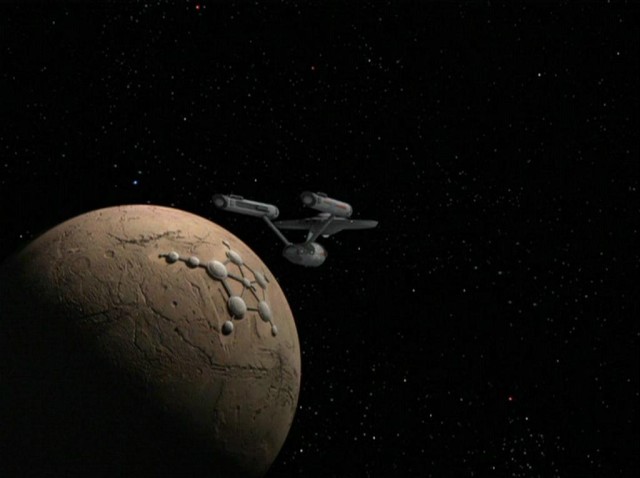
In this first post, I take a look to Memory Alpha, as it appears in the episode “The Lights of Zetar” (1969) of Star Trek the Original Series (TOS for geeks). Memory Alpha is a planetoid which houses a huge library complex set up for academic purposes. This library contains the total cultural and scientific knowledge of all the planets that are members of the United Federation of Planets. Memory Alpha is also the very apt name chosen for one of Star Trek’s wikis on the Internet.

In this episode, the action takes place in the planetoid. However, not much is said about the library itself nor it is an important plot device on itself. According to the Memory Alpha wiki, “as of 2269, the library complex was an array consisting of five large and seven smaller domes on the surface of the planetoid. Aside from the technicians, the occupants of Memory Alpha varied with the number of scholars, researchers, and scientists from variousFederation planets who were using the computer complex at any given time.” The most relevant element that I can bring to this post for discussion is that there is an attack on Memory Alpha and then Mr. Spock comments regarding the nature of the library that because they considered that the knowledge stored there is to be accessible to everybody, they did not put a force field to defend the planet. A force field in Star Trek is an energy field put into place around ships or places as a line of defense and it prevents life forms to “beam” or being teleported to a place without permission.
This is a very interesting point, if we think about the history of libraries, the first libraries were reserved to the elites, usually knowledge was only accessible for members of the royalty or religious people, and not the general public, which is all the purpose of libraries of the current age. It is a shame that because of enforcing to the limit a free access to knowledge, this library was vulnerable and attacked. There is no easy answer on how to provide universal access and at the same time protect the place where information is stored. Even so, this is the most interesting portrayal of libraries in Star Trek TOS. I see that Open Access is a common trait on the handling of knowledge and information policies in the Star Trek universe (at least by planets of the Federation). I can guess that in posterior series computers get a major upgrade in storing space as we can see for example Captain Picard (The Next Generation) browsing through music or also Captain Janeway (Voyager)  using the Federation digital library to bargain for a transportation device. An interesting topic to debate from Star Trek mythos is Copyright an Open Access. However, that is a topic for another instance of Libraries & Information in Media.

Steve Jobs 1955-2011

“… You can’t connect the dots looking forward; you can only connect them looking backwards. So you have to trust that the dots will somehow connect in your future. You have to trust in something – your gut, destiny, life, karma, whatever. This approach has never let me down, and it has made all the difference in my life.”

“Design is not just what it looks like and feels like. Design is how it works.”

Rest in peace Steve, thanks for the gear and your inspirational way of presenting!!

New direction

A new direction on the blog is coming. I realized after Doris created her own blog (Check it out!!) that she, and of course I also tend to prepare so carefully every post. So I come up with very long and polished posts. But at the same time, I think that goes against the whole purpose of Internet culture and social media these days.

You may have seen that in 2010 and until now this blog was very much unattended, except the long and perhaps a bit controversial last posts.

While I was doing my master thesis I couldn’t get to write too much and then I didn’t even write a post for it! That’s coming. My new job (almost finished now), studies and all the changes in life undermined my blogging, too. Let’s see how it goes.

From now and specially from July, I’m changing to shorter and more frequent posts. As always, you can check what I read and like on the Internet through the Tumblr.

Cheers!

Random Rant

At the time of writing this, I am in Athens, on the occasion of an international conference. After our respective presentations, which were very well received (I believe), we took the occasion to relax a bit and have a couple of beers and a good conversation.

Between jokes and serious talk (both these tones use to get confused in a dialog among friends), we were talking about some of our favorite topics as we do whenever we have the chance to meet. With this friend we talk about our experiences studying our PhDs abroad, the copyright industry’s battle against piracy, open access, alternative business models, the good “old” Wikipedia, the Internet, and digital culture in general. Today’s conversation was about how, in a way, we see ourselves almost as outsiders when in conservative academic circles. This isn’t the case of this conference, I must point out, as we were not criticized and I believe both our researches were well received by the academics present.

For example, on one side, my friend is using a grounded theory method on his research about metadata, he is interviewing mostly young researchers and academics from the LIS field. He told me he has been highly criticized because of the method he is using and even some have told him: “why metadata?” (WHAT!!) More than as a friend, I think even as a colleague, I believe in his research. I told him: what is the problem? Aren’t there already enough research done in a more traditional top down way with tried and good approaches or theories?

This is also applicable to my own PhD research, where I take an action research perspective to study the use of social networking tools in higher education. Possible critics may very well point out the highly subjective charge of my research, by making direct interventions on the activities I give to the participants. But then, isn’t learning one of the most subjective processes? We are not machines.

We argued that we get very weary and a bit tired at times of the old debate of positivism vs. constructivism, or objectivism vs. subjectivism. I believe there is not a single phenomenon in social sciences or humanities for which someone has found an absolute, universal, measurable and replicable truth.

I don’t remember where I saw it, perhaps you can identify where I got this piece of quote without author: “The outcome or goal does not matter, the most important thing is the journey.” All the insights you could get around a problem or a phenomenon subject to study; or all the discussion that leads you to your findings. Isn’t that good enough on the social sciences and the humanities?

2010 in review

The stats helper monkeys at WordPress.com mulled over how this blog did in 2010, and here’s a high level summary of its overall blog health:

Healthy blog!

The Blog-Health-o-Meter™ reads Fresher than ever.

Crunchy numbers

Featured image

A Boeing 747-400 passenger jet can hold 416 passengers. This blog was viewed about 2,800 times in 2010. That’s about 7 full 747s.


In 2010, there were 4 new posts, growing the total archive of this blog to 28 posts. There were 2 pictures uploaded, taking up a total of 149kb.

The busiest day of the year was March 9th with 113 views. The most popular post that day was Venezuela bans videogames.

Where did they come from?

The top referring sites in 2010 were kotaku.com, facebook.com, search.conduit.com, judamasmases.wordpress.com, and google.es.

Some visitors came searching, mostly for the beatles, mars attacks, sealand, bride of the monster, and mars attack.

Attractions in 2010

These are the posts and pages that got the most views in 2010.

1

Venezuela bans videogames March 2010
3 comments

2

The Beatles 2009 remasters October 2009
2 comments

3

Mars Attacks Micro Review May 2009

4

Entrevista sobre Alfabetización Informacional April 2008
5 comments

5

On the Pirate Bay, its trial and The Industry (1) April 2009
9 comments

Censorship in videogames: the Manhunt 2 case

Once there was a little videogame by Rockstar called Manhunt 2, which entered its development stage in 2004. In 2007 this game was submitted to two of the most important rating boards for games, the ESRB (USA) and the BBFC (UK), and both of them refused to give them a certain rating which is the maximum rating allowed for a game to be released in a home console. In the case of the ESRB, the rating given was an Adults Only (AO). In order to release the game on the Wii or the PSP they would have needed up to a Mature rating (M). So Rockstar was forced to modify the game to submit it again. In the USA was accepted after this, in the UK it was a bit more difficult, as the modified version was rejected again. Finally, it was released with a delay of nearly a year because of this issue and the version you can find all over Europe is imported from the UK. I haven’t found information about what happened about the submission to PEGI and I bet Rockstar didn’t even want to try with the Australian ratings board! But anyway, this is enough background information.

I was in Norway when I bought the imported version of Manhunt 2 and my impression was “interesting”, it was a stunning, shocking videogame. I’m sure all the controversies, scandals and the ratings issues just raised the hype and the game didn’t let me down in this respect. You just escape an asylum (just like Arkham) not knowing who you are and just wonder around finding clues, moving slowly by the shadows and executing people with a wide variety of weapons and environmental kills. Of course I wondered how would it look uncensored. The funny thing is that it is a disappointing game in other aspects. Graphics, depth, simple but very hard gameplay. Although the story and atmosphere are very good. However, I don’t want to talk about the quality of the game itself either.

The way Rockstar censored the game was around the executions, they put a lot of noise effects and video filters over the action so you can’t see quite right what’s going on.

All these are old news, my point is that I just played an uncensored version of Manhunt 2 (without any video filters), and I can tell you that the censored version is WAY more creepy, violent, explicit and disturbing! I think this sensation is caused exactly by the way it was censored, it leaves more to the imagination, and the imagination is just being unleashed by the outstanding atmosphere of the game. Your imagination fills in the gaps of the filters, and the filters themselves make everything more creepy.  You might ask: So the game is not violent/creepy without the censorship? Yes, of course it is. However, the gore is minimum and sometimes the camera just goes away. I suppose both these elements are related to the limited power of the Wii or the PSP. We have seen more gore elsewhere anyway.

I think if the objective of the rating boards was to make sure the softest version possible of the game would be released, they failed, miserably. It is interesting to take this point and make a generalization that sometimes do happen: when attempting to censor or criticize something and make a scandal out of it, the outcomes are the totally opposite than the ones conservative people want to make. Sometimes they give more force to what they want to hide. I’ll touch this point again in another post, also related to videogames.

Revenge of the Nerds Micro Review

Revenge of the Nerds (Jeff Kanew, 1984). This movie is very good and entertaining and it has aged well. Check out the musical number in DEVO/Michael Jackson style! Maybe nerds have a bit more respect nowadays, or at least some of them have proven to be very successful people. In a broad sense this is one of those American movies were two very different groups (one of them dysfunctional) clash or battle with each other, and the viewer has the chance to side with one of them. You have the Nerds, of the fraternity Lambda Lambda Lambda which are sort of the “ugly ducklings” or anti-heroes of the story and the other are the Pi Delta Pi  and the Alpha Betas which are depicted as the “normal not nerds” kids, for me these are the villains. If you don’t side with the Nerds while watching the movie, then you must have problems.

I’m making this review a bit different by adding the following sort of social commentary. It is really sad to see some things happening in the movie happen today: bullying / cyber bullying. In some learning environments, there is a tacit belief that the stronger or the most apt in sports can and shall dominate other students weaker in these areas. I think I was very lucky that in college I had a very normal and pleasant life, there are no such things as fraternities in the country I studied my Bachelor degree and I think that the fact it was a public university also helps in that because of the high diversity there, these problems don’t happen too often. The previous time I saw that movie must have been like 12 years ago and maybe I didn’t understand it as I see it today. I really hated the characters of the “normals”, I even couldn’t stand them on screen! I already told you it was easy my pass through university, but high school was a different story, there was a certain person who studied almost all the way since primary with me, hated that stupid piece of s+++t. It was the bully of the school and the school even promised several times they would get him out, but they didn’t and no corrective action worked with him. I think now in retrospective that his only presence after some years influenced the environment so everything and everyone were kind of at his service, even girls and teachers. I think this environment did some terrible things to me, as for example I was not very confident in many ways when I was a kid, sucked at sports (except the last two years), my performance just declined with time, I felt depressed some times and well, overall my self confidence was very low and I believe that some of the decisions I took just at the end of high school and at the beginning of college years were affected by this. I think bullies can undermine the lives and hopes of other students who don’t decide to confront them, and also for the student who just go with it. I sadly just confronted him a couple of times, if I were to live again those years I’m sure I would kick his sorry ass very badly. But now I’m proud to say that I overcame most of my insecurities and issues created by high school’s fault. Like Lewis in the movie I decided to take a stand and I even recovered the best girl from the evil clutches of the bullies. And yes, I’m a Nerd!

The Beatles 2009 remasters

beatles_stereo_box_set

OK people! I was really expecting for these to get released since a long time ago, I grew up listening to the Beatles and I have almost all their albums in compact disc. The Beatles as opposed to other major British artists like Pink Floyd, David Bowie or The Rolling Stones, have not had a really digital remaster release of their career, it was a shame really, that all we had as standard editions were the first 1987 masters, the first and only release of their music on CD if we don’t count the Anthologies, Capitol Years Box, and the most recent Love. After Love was released with this very fresh sound everybody was expecting new remasters for the Fab Four albums. I myself had to buy the album Love via an Internet store we have in Venezuela and pay more than 5 times its price because Venezuelan music stores went insane before this and they were always crazy about pricing The Beatles music, the album Love was priced about 15 times its normal price (about $100). But the rants against overpricing in my country are material for another post.
beatles2This music is great I have really fond memories of listening to The Beatles throughout my life, great moments enjoying with my friends especially the tracks A Day in the Life form Sgt Pepper Lonely Hearts Club Band and Strawberry Fields Forever form Magical Mystery Tour. It’s funny that I even thought of a classifying system for people who listen to the Beatles, in a broad sense you have the people who likes the first part of their career from (Please Please Me to Help) and the people who likes the second part (from Help to Let it Be), they have two very differentiated stages, you know, when they started “experimenting” when I really think the music turned a lot more interesting, when I started listening to them I really liked the first stage of their career, but from some years ago I prefer the second stage by far. So my theory was like: the first stage is more likely to be liked by children and people in their 60s or more and the other part to people below 60s, of course, this is no proven truth, it’s just silly speculation. I also have my friends who don’t like The Beatles at all and prefer The Rolling Stones over them…
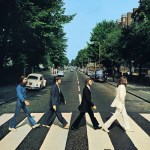
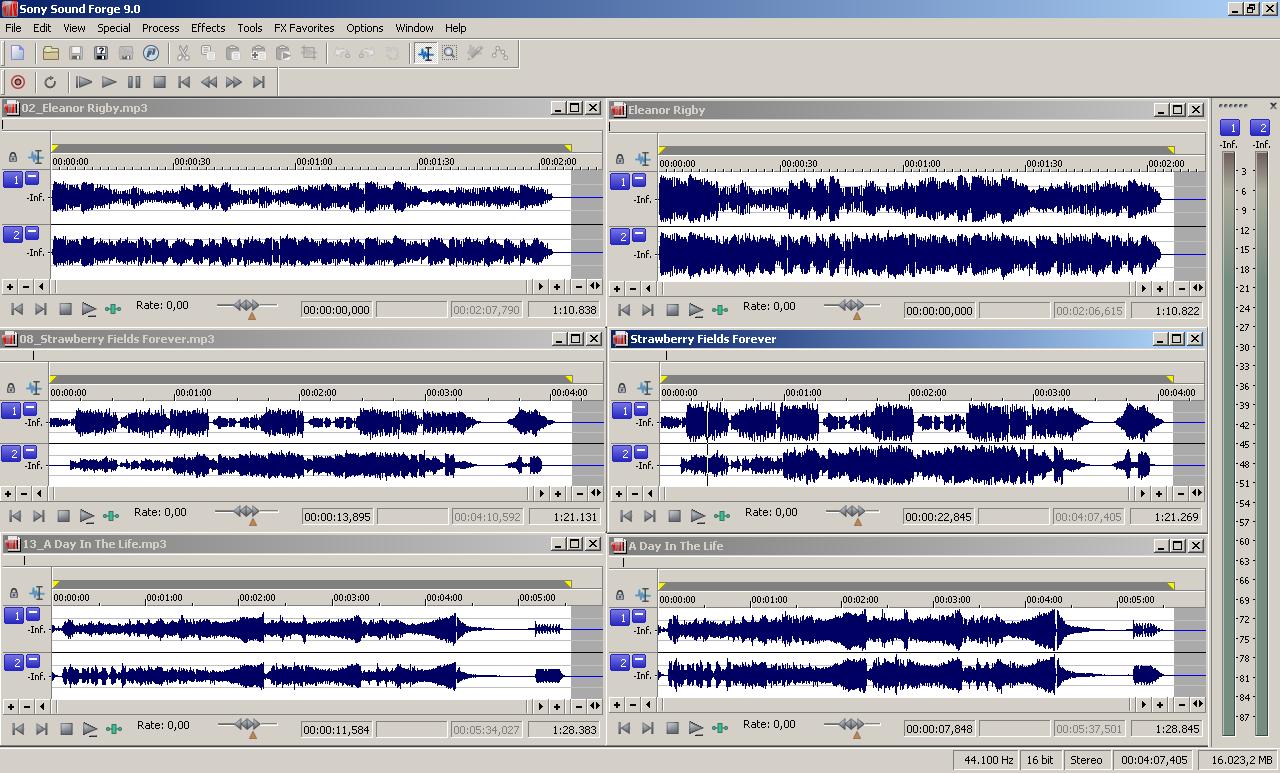
beatles_-_abbey_roadAbout this 2009 remasters themselves, I haven’t listened to everything there is yet as I wait to buy it all later this year as a boxset, but I can tell you that so far I heard, the music sounds louder, and maybe sounds a bit brighter. Maybe, the expectation and anticipation was too high that I was expecting something more impressive, but don’t get me wrong, I love the music and must probably will buy the full boxset of the remasters, I also have to compare the two editions with more equipment, I have heard just a couple of albums with my laptop with its own speakers (Altec Lansing) and the iphone default headphones using Winamp. I would like to share with you an experiment I made putting 3 tracks from both remasters in Soundforge (click to enlarge), we can see that the soundwaves are indeed different, but its only a question of volume that’s changed? Or there’s more to it. Please comment your experience with the 2009 remasters.

beatles

On the problems of liveblogging events

I just finished reading my bulk of unread google reader items, well, I have to actually mark as read the subscriptions which always grow too large to handle, and I found that my colleague aubreymcfato has put on one of his reviews of the ECDL 2009, conference that we attended together, a small note from Joho the Blog by David Weinberger that describes really good the experience and the feel of being liveblogging about events we are in. This is really valid for my first post on ECDL and the upcoming ones on the conference or of the same nature, that is, notes taken while I’m hearing some presentation or something of the sorts. I’m sorry for any lack of accuracy. David Weinberger’s disclaimer is the following:

“NOTE: Live-blogging. Getting things wrong. Missing points. Omitting key information. Introducing artificial choppiness. Over-emphasizing small matters. Paraphrasing badly. Not running a spellpchecker. Mangling other people’s ideas and words. Posted without re-reading. You are warned, people.”

Dark City Micro Review

Originally published on judamasmas s-tumblrs

Dark City (Alex Proyas, 1998) must be one of the most underrated films of the 90’s, beign almost a failure at box office performance, it has earned with the passing of the years high acclamation from movie critics (strangely perhaps? like Roger Ebert) and audiences, becoming a cult classic. This movie presents you with a simulated reality story, it wasn’t a new way of storytelling at that time, but for further enjoyment of this movie you have to consider that it was released one year before The Matrix. In this fictional world a race of aliens called simply the Strangers have enslaved humanity without them to realize what’s happening. I said enslaved? it’s better to say that they are having a huge experiment with humans in order to find a solution and prevent their annihilation. The experiments consists in that they are changing the shape of the city every night, or maybe to say night is not so appropriate because there’s no sun (that’s why the movie it’s called dark city), so they change the shape of the city once in a while, replace the people’s memories and swap their location on the city. But the moving force of the movie, speaking in other movie’s language starts when an anomaly or an unexpected value affects the equation. John Murdock is the main character in the movie and he’s a human with the same psychokinetic powers as the Strangers, he’s lost his memories and has been framed with murder by the Strangers. So the movie it’s about him trying to make sense on what’s happening while escaping the firm grip of the Strangers. So, the rating, I give this movie a perfect score, it’s actually one of my favorite movies ever. The performances are excellent, Rufus Sewell makes a good main character but not amazing, but we have the strange scientific in Kiefer Sutherland, the police detective in William Hurt and OH MY GOD!! my love Jennifer Connelly is the wife of the protagonist and she sings! (actually only sings on the Director’s Cut), the Strangers look very evil and disturbing so they are great bad guys. On the effects side, special mention on the morphing sequences of the city. Music is very good and it always emphazises the menace of the Strangers and keeps you on your toes. The story, my favorite part, is simply amazing, it’s based on the always amazing argument, y’know? maybe nothing is real…