Recovering troubled cities through public spaces and libraries: The Caracas Metropolitan Strategic Plan 2020


Sin título

Together with my fellow contryman, Renny Granda, public libraries’ own knight, we published the third part of the Caracas Trilogy (see first part and second part), where we invite you to reflect upon the question: could public spaces and libraries help us reducing violence in Latin American cities?


Abstract: The Caracas Metropolitan Strategic Plan 2020 (CMSP2020) is an instance of urban and environmental planning that seeks to construct a collective ‘city pact’ for Caracas, currently among the most troubled and violent cities in Latin America. Its main idea is to recover the city through the rescue of its public spaces, by centering on six strategic axes for transforming Caracas: accessibility and mobility; public safety, public spaces and housing improvement; environmental sustainability; productivity and entrepreneurship; governability; and the development of a constructive and responsible citizenship. This model, partly inspired by Medellin’s Library Parks, may be useful for other large cities in the region that suffer similar socio-political fractures, as well as accessibility, mobility, environmental, productive, governance and safety issues.

Full text at Sage Publishing

Open Access version (Coming soon!)

Recommended reference: Granda, R., and Machin-Mastromatteo, J. D. (2018). Recovering troubled cities through public spaces and libraries: The Caracas Metropolitan Strategic Plan 2020. Information Development, 34(1), 103–107. http://doi.org/10.1177/0266666917741069


Latin American triple-A journals 1: A quality roadmap from the quality indicators and journals’ presence in Web of Science and Scopus

The new Developing Latin America, co-authored with Javier Tarango and Eduardo Medina-Yllescas is out. In this issue, we analyze the current presence of Latin American journals in Web of Science and Scopus, as the first part of a quality roadmap intended to strengthen regional publications, especially those that have started as institutional publications. Dedicated to the loving memory of Cristobal Salvador Gómez Contreras (1992-2017).


Abstract: The current presence of Latin American journals in Web of Science and Scopus is analyzed, as the first part of a quality roadmap intended to strengthen regional publications, especially those that have started as institutional publications. The next issue will study the quality requirements and journals’ presence in other recognized indexes and platforms such as Scimago Journal and Country Rank, the Directory of Open Access Journals, Latindex, SciELO, and RedALyC.

Full text at Sage Publishing

Open Access version

Recommended reference: Machin-Mastromatteo, J. D., Tarango, J., and Medina-Yllescas, E. (2017). Latin American triple-A journals 1: A quality roadmap from the quality indicators and journals’ presence in Web of Science and Scopus. Information Development, 33(4), 436-441. http://dx.doi.org/10.1177/0266666917718138

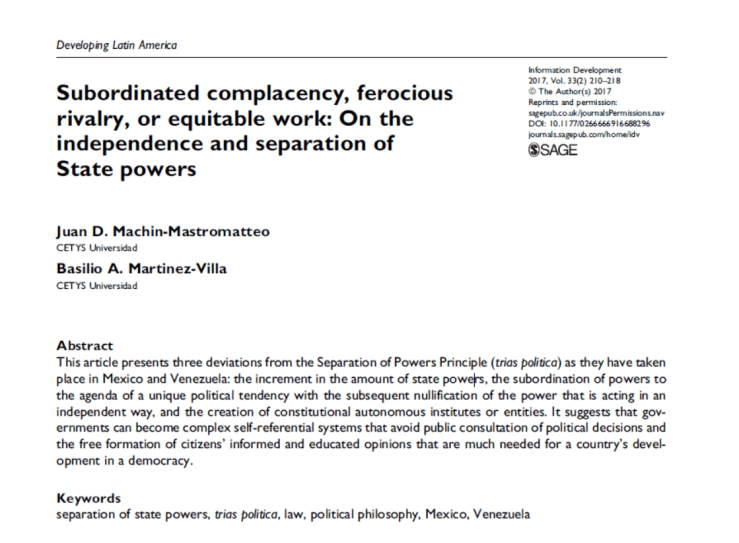
Subordinated Complacency, Ferocious Rivalry, or Equitable Work: On the Independence and Separation of State Powers

subordinated


Now in #OpenAccess, 2017’s ‘On the Independence and Separation of State Powers’, written with Basilio A. Martínez-Villa. Original English version: https://papers.ssrn.com/sol3/papers.cfm?abstract_id=3466595


Abstract: This article presents three deviations from the Separation of Powers Principle (trias politica) as they have taken place in Mexico and Venezuela: the increment in the amount of state powers, the subordination of powers to the agenda of a unique political tendency with the subsequent nullification of the power that is acting in an independent way, and the creation of constitutional autonomous institutes or entities. It suggests that governments can become complex self-referential systems that avoid public consultation of political decisions and the free formation of citizens’ informed and educated opinions that are much needed for a country’s development in a democracy.

Full text at Sage Publications

Open Access version

Suggested citation: Machin-Mastromatteo, J.D., & Martinez-Villa, B.A. (2017). Subordinated complacency, ferocious rivalry, or equitable work: On the independence and separation of State powers, Information Development, 33(2), 210-218. https://doi.org/10.1177/0266666916688296

I already published my research, what now?

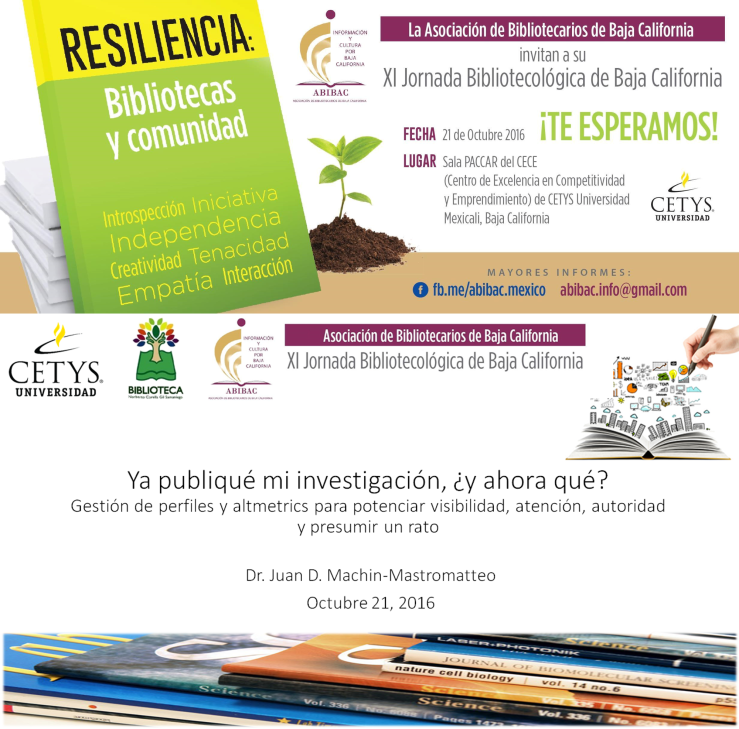
On Friday, October 21, in the XI Librarianship Meeting of Baja California, organized by ABIBAC, Asoc. de Bibliotecarios de Baja California, A.C., taking place in CETYS Universidad, campus Mexicali, I presented the workshop for librarians/researchers: ‘I already published my research, what now? Profiles management and Altmetrics to enhance visibility, attention and presume a little bit’.

The objective of this workshop was to provide tools, strategies and procedures so that information professionals and libraries can support researchers in promoting their research published in scientific journals using international professional networks and channels for this purpose.

The contents presented include the definition of professional networks and channels for the promotion of scientific publications, as well as a strategic workflow that every researcher should use in order to promote and gain value in terms of their visibility, attention and authority as scientists.

The importance of this type of workshop is that if information professionals and libraries manage the formal channels for the promotion and metrics of the scientific publications evaluation, elements that are within this discipline, they can position themselves with a vital role within the processes of scientific communication in their institutions. These issues also represent some important support for researchers, since they usually do not do it themselves because of time constraints or ignorance. However, conducting an appropriate promotion through the relevant scientific channels, networks and indexes are key activities for enhancing the visibility of a researcher, to ensure that their intellectual production is read and cited, which will allow them to be part of the National Researchers System, access research funds, or collaborative projects, as well as reaching other national and international merits. All these are important issues for higher education institutions, although some of them will not want to address these issues or will fail to recognize them, as the area of research and intellectual production becomes more important as an element used to evaluate the capacity and quality of an educational institution. Topics such as those discussed in the workshop reinforce institutional research plans, since they are basic strategies for the intellectual production carried out in institutions to generate a greater impact, which allows increasing the number of researchers who have distinctions and are internationally recognized as authorities In their areas. This means that educational institutions gain greater visibility, recognition and positioning as knowledge-generating institutions and are more favorably evaluated in international

Some media outlets selectively reported on the event:

http://monitoreconomico.org/noticias/2016/oct/21/cetys-sede-de-la-jornada-de-bibliotecologica-de-bc/

http://www.cetys.mx/noticias/somos-sede-de-la-xi-jornada-de-bibliotecologica-de-baja-california/
Presentation at ECIL 2016: Assessing spanish-speaking university students’ info-competencies

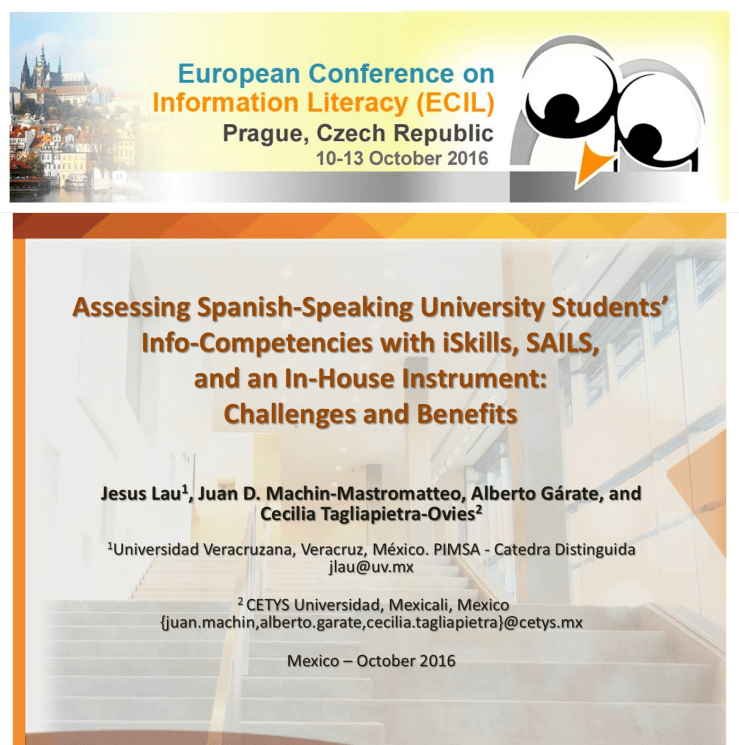
Our presentation at #ECIL2016 in Prague: ‘Assessing spanish-speaking university students’ info-competencies with iSkills, SAILS, and an in-house instrument: Challenges and benefits’ was a success! Coauthors: Jesus Lau (presented at the conference), Juan D. Machin-Mastromatteo, Alberto Gárate, and A. Cecilia Tagliapietra-Ovies. #CETYS and its information culture are very fortunate, as it has been in the European Conference on Information Literacy for the fourth year in a row.

How to publish in a scientific journal of the Social Sciences

Very thankful with CONRICyT for having recorded and shared my #EntrePares presentation: How to publish in a scientific journal of the Social Sciences field

Inclusion of information literacy in the curriculum through learning communities and action research

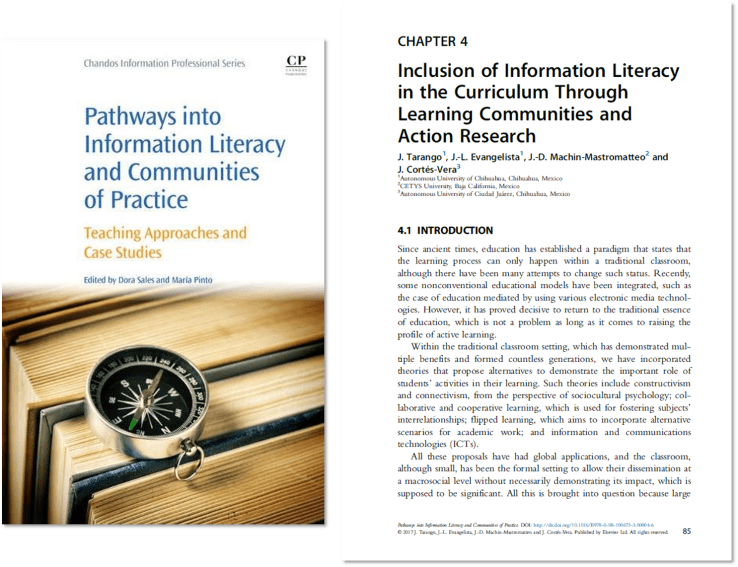
The book ‘Pathways into information literacy and communities of practice: Teaching approaches and case studies‘ is now available by Elsevier-Chandos. In it, you will find ‘Chapter 4 – Inclusion of information literacy in the curriculum through learning communities and action research‘, co-written with my dear colleagues Javier Tarango, José Luis Evangelista y Jesús Cortés. The whole book is highly recommended, edited by Dora Sales y María Pinto.

Abstract: This work corresponds to a practical and transversal integration process of information literacy in university curricula, specifically with undergraduate students from the philosophy program of the Autonomous University of Chihuahua (Mexico), by developing alternatives to evolve traditional classroom teaching practices toward integrating learning communities and using action research as means of influencing a continuous improvement upon learning processes. This chapter discusses basic concepts from this study and provides the results, which were a product of the data collected from ethnographic processes. This practical experience has demonstrated the feasibility of combining this study’s components for the achievement of active learning, but also for identifying specific elements that inhibit a full implementation. http://dx.doi.org/10.1016/B978-0-08-100673-3.00004-6

Open Access version

Certified Sentinel of Science, 2016 award by Publons.com

Publons, a website that created a system for recognizing the value of an activity rarely taken into consideration: peer review has awarded me with the title of Certified Sentinel of Science, for being among the top 10% of best reviewers in the Social Sciences field at a worldwide level. Have you performed peer-review activities? Try creating your profile at http://publons.com to get recognition for it, it’s well worth it! You can also have a look at my profile.

Piracy of scientific papers in Latin America: An analysis of Sci-Hub usage data

untitled

In the new issue of Developing Latin America: ‘Piracy of scientific papers in Latin America: An analysis of Sci-Hub usage data’, co-written with dear colleagues Alejandro Uribe-Tirado and María Elena Romero-Ortiz, we present Sci-Hub’s characteristics, a criticism to its perception as a de-facto component of the Open Access movement, its implications for information professionals, universities and libraries, and we replicate an analysis published in Science, but using only Latin America usage data. Ever wondered how many papers are illegally downloaded from Sci-Hub in the region? Find also the answer of how illegal downloads compare to legal downloads done through the Mexican and Argentinian scientific information consortia.

Acknowledgements: we wish to thank the InfoTecarios group for informing about regional challenges, specifically the help of Saúl Equihua, Myrna Lee and Renny Granda; and comments received from Dominique Babini, Paola Azrilevich, Alejandra Méndez, Luis Rojas, Nitida Carranza, Sonia Amaya, and Dr. Elsi Jiménez.


Abstract: Sci-Hub hosts pirated copies of 51 million scientific papers from commercial publishers. This article presents the site’s characteristics, it criticizes that it might be perceived as a de-facto component of the Open Access movement, it replicates an analysis published in Science using its available usage data, but limiting it to Latin America, and presents implications caused by this site for information professionals, universities and libraries.

Full text at Sage Publishing

Open Access version

Recommended reference: Machin-Mastromatteo, J.D., Uribe-Tirado, A., and Romero-Ortiz, M. E. (2016). Piracy of scientific papers in Latin America: An analysis of Sci-Hub usage data. Information Development, 32(5), 1806–1814. http://dx.doi.org/10.1177/0266666916671080

How to publish in a Social Sciences scientific journal #EntrePares2016

I was invited by Sage Publishing and EBSCO to deliver the workshop ‘How to publish in a Social Sciences scientific journal’ in the #EntrePares Seminar 2016 in San Luis Potosí, Mexico. Many thanks to my hosts, the seminar organizers, and specially the public who were very interested and asked many interesting questions! It was my pleasure; and it is such an honor to have received this beutiful award from the Universidad Autónoma de San Luis Potosí and CONRICyT.
Very thankful with CONRICyT for having recorded and shared my complete #EntrePares presentation (Spanish only):


And here are the presentation slides: