Venezuela bans videogames

As a kid there were two things that encouraged me to explore new worlds and learn English: rock music and videogames. Some days ago in Venezuela, my place of birth, they started to enforce a law to practically ban videogames., with fines from 30.000 to 60.000 US$ and prison time from 3 to 5 years for those who import, sell, distribute and (use?) videogames. That is very sad for me, as Venezuelan and as a gamer. I feel they are closing a way for kids to learn English with games to have more and better opportunities than the ones who don’t develop language skills (it is important to note that before the current generation of game consoles, which are multilingual, we had the same North American releases, in English). The major driving force behind the law is to protect children from violent games, a thing in itself very plausible, but is a total ban we are talking about, ignoring any age rating system that exist or the rights of adults to enjoy these products as well.

The law’s name is Law for the Banning of Videos and War Toys. It is no secret that there’s a huge problem of crime and violence in the country, this is one of the premises supporting the law, as the congress state that “there are scientific studies that prove there is a notorious influence on the future citizen’s conduct and the activities they do in the games”. But how about the incendiary speeches of most of the politicians in the country? And the possession of guns among the civil population and the shootouts in the slums? How about the continuous acquisition of guns, weapons, planes, submarines, etc? The almost declarations of war with neighboring countries?

The politicians at the congress indicate that this law “is not going to solve the problem of the violence, but it opens a space, a positive scenario for the discussion in different areas, nationally and internationally”. These statements only show the shortsighted criteria used by the politicians to make this law, how do you open a space for discussion with a total ban? It’s like in the United States with the prohibition, you only encourage the creation of illegal channels and businesses which is way worse as history has proven. As a gamer, I had to cope up with the problems of distribution of games in Venezuela, there are no GameStops, so there were independent importers who could charge you up to 140 US$ for a game and about 900 for a console (these were numbers I found out between December-February when I went to Venezuela), now with all videogames related economy being illegal, how much should be the price for an original game?

As many of the country’s laws intended to censor something, the solution is to ban, to punish or close,  like they did with the radio stations they closed, with the television channel they had the luxury to close two times, can one be critical? No, the government won’t even try to find a middle ground, to cite a Venezuelan politician: we have a clash of classes.

Some could say that the law is not a total ban, but it’s so vague, so we can be talking about that stomping on goombas or racing a kart while throwing turtle shells is violent and war-like.

So it’s Game Over and no Continues left, it’s a sad, sad day…

How checking an online library catalog can be a geeky travel to the past

The National Library of Venezuela offers one of the most unique experiences in online library catalogs. To be able to check the catalog, you need to go first on a part of their website where you have the instructions on how to use it, only in spanish for now, but take my word on them.

First you will need a software to uncompress files, like Winizip or Winrar, then you have to download a “3270 emulator” for Windows, sorry, no Linux or Mac OS support for now, but works on Vista and 7, so that alone it’s pretty cool. As for this 3270 emulator, Wikipedia says it’s “a computer program that duplicates the functions of an IBM 3270 (manufactured c.a. 1972) mainframe computer terminal on a PC or similar microcomputer.”

So, following the installation of the emulator, configure the IP to 200.90.17.68 and you will enter the automation suite ND-NOTIS. Again, taken from Wikipedia: “ND-NOTIS was a tightly integrated yet modular office automation suite by Norsk Data introduced in the early 80s, running on the SINTRAN III platform on both ND-100 and ND-500 architectures.”
Now there’s no more mouse input for you, so you have to login and input commands using only the keyboard: you press “b”, then “Enter”, then “Tab”, you put in the username “OPERATOR” and password “OP3RAT0R” (pretty sneaky, huh?), then “Enter”, “F10” and write in caps the word “LUIN” and… VOILA!

Cannibalize Yourself Forever!

image002

Between 2002 and 2005 I managed to bring together a group of students from various schools of the Central University of Venezuela in a rather heterogeneous group, but with the common interest of writing literature. The first years we had no visible name or voice, but it was in 2005 that we really made university hear about ourselves, we found we could register the group as a group of university extension, which we did. With this request we could request the use of the auditoriums and halls of the Faculty of Humanities, pay for a few hours. We did some presentations on these places, also in the open areas of the University, in the classrooms we made our literary meetings and on the Internet we found a way to communicate and disseminate our writings. 2005 was our golden age, but  at the end of that year, the group disappears and today in 2009 the site where the magazine  was will be closed as Yahoo Geocities service changes and becomes a paid service, so I post t his invaluable material on my blog to rest and inspire. Let this be a reminder of something we accomplished and to be as well a tribute to the  Canibalización Aleatoria (Random Cannibalization Group) and all the poets who were part of it. Sometimes I feel nostalgia for the time we spent together, all that we did and also the material produced, its quality fills me with pride, although I would like the group to continue to exist, but I know time and distance are factors difficult to overcome. Without further ado I present the 5 numbers of the Venezuelan Experimental Literary Magazine Canibalízate. Enjoy them. (Only in Spanish, sorry).

No. 1

No. 2

No. 3

No. 4

No. 5

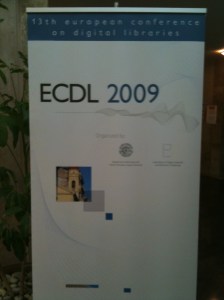
ECDL 2009

Picture 074

Hello again!

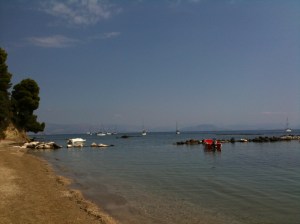
I’m lucky to be right now in Corfu, Greece where I’m attending with my fellow DILL colleagues the 13th European Conference in Digital Libraries. More or less as part of the third semester of the DILL master and thanks to our Professore Vittore Casarosa we have been attending this wonderful, high profile conference in the field of Digital Libraries. As you may or may not have seen, I’m tweeting about the conference, but to complete my own coverage on it I decided to post some things in the blog. So, in this post I will present an outline of what was the first day of conference (09-28-09). Enjoy.

Picture 043

Keynote: Digital Libraries as Phenotypes for Digital Societies

by Gary Marchionini

This 13th edition of the European Conference on Digital Libraries (ECDL) started with “a bang”, with a very interesting keynote by Gary Machionini, titled Digital Libraries as Phenotypes for Digital Societies. Marchionini started with the statement that Digital Libraries gives us a lens on what we are becoming in the digital age, he then defined some characteristics of the digital societies, such as the following ones:

They are determined by topic or interest of individuals or communities, rather than by the geography, because ICTs bridges people regardless of their location. Of course, digital societies are dependant on technologies and electronic infrastructure. They are driven by weak ties, this can be seen in social networks such as facebook where one “collects” contacts or friends that you don’t actually have to know personally, the acquaintance process is very different than in the “real world society”. Individuals in this digital society are also extremely diverse, if the location makes little difference, people interacting in a network come from different places and that makes them different, different culture, religion, behavior, etc. Digital societies grow fast, we can say they are viral, but at the same time they can lose members at the same speed, they are not so sustainable, as the fidelity of the members it’s different from person to person. These societies of course are based on our “real world society” and interact with traditional institutions.

Next, Professor Marchionini defined the Phenotype of Libraries:

  • They are social organisms.
  • Have foundational and policies that reflects their institutional genetics.
  • The influence of the environment affects their collections and services.
  • They reflect the social organizations that support them.

Digital Libraries are active workspaces, it’s not enough to set up collections multimedia streams, systems exhibit behavior, this means there’s a memory on them, they are dynamic and interactive, these interactions are kept as a general history (like a website history on an Internet browser), and users interactions should be considered part of a Digital Library collection, these interactions are made by their annotations, comments, news feeds, tags, crowd sourcing, and as a collection, these contributions must be managed.

Key challenges

  • Content and context: selection management.
  • Preservation: What’s worth preserving? What context to include? Who decides? Who pays? How much? Storage models: replication (copy) migration (change of format, impractical), emulation. Storage policies (authority, cost) Storage challenges: space vs price vs reliability.
  • The new Alexandria: distributed content and stakeholder, self organizing content, human-machine hybrid, new kinds of trust management.
  • Managing participation and services: a symbiotic human-machine relation
  • Content Genetics: born digital documents, hybrids from traditional libraries.

DL Collection models Born digital variants:

  • Curated by expertise (Perseus)
  • Curated by expertise opportunity (Open Video)
  • User contributed without curation (ibiblio)
  • User contributed with community curation (wikipedia, youtube)
  • Computed (citeseer, technorati, google?)

Picture 011judamasmas’ comment: this was a really amazing presentation, I liked it a lot. I also think is important to take into account that the users of the library could create valuable content and that this same content can be part of our actual collections. I think we have some lessons to learn and some features to import from the worlds of open access and social networks, because our way of building collections may not be very attractive by itself and funding is getting more an more difficult, just to cite two reasons.

After Professor Marchionini finished his keynote presentation, we went for a coffee break in this really nice and beautiful Hotel Corfu Palace. After the break it was decision time, because they were two sessions in parallel: one on interaction and the other one in knowledge organization, I decided to go to the interaction session. You can find information on the other one in the tweets of my colleague Andrea in twitter (aubreymcfato) or in his blog questoblognonesiste.

Session 2A: Interaction

Hear it: Enhancing Rapid Document Browsing with Sound Cues

by Parisa Eslambochilar, George Buchanan and Fernando Loizides

It is interesting that the presented started stressing the point that in Digital Libraries interfaces are silent, like in “real world libraries”, but has it to be like this?

Document readers have attempted to help users locate new or unknown information and there has been success with providing visual target cues.

Some of their findings:

Audio seems to permit faster movement and higher zoom levels, it could be improved by better timing the cues, allowing for delays.

Future works:

Evaluate anticipatory cue timing, reconsider performance with improved cue, compare against tactic cues.

judamasmas’ comment: We can think that this could be a good multidisciplinary work because it could involve librarians (digitals or no!), experts in sound media (recording, storing and playing), and even psychologists.

Creating Visualizations for Digital Document Indexing

by Jeniffer Pearson, George Buchanan and Harold Thimbleby

Goals:

Combine elements of digital and print indexing search, understand the properties of search in digital documents

They created a new interface, the digital index viewer: builds traditional index from digital document, with number of occurrences on which pages for different words.

Different presentations of the digital index viewer:

  • Color Tag Clouds: red indicate many occurrences (as it represent hot temperature) and blue indicate few occurrences of the term (as it represent cold temperature)
  • Tag clouds: the bigger the more occurrences
  • Graph: the bigger the more occurrences

User performance on speed of search: traditional index < color tag cloud < graph

judamasmas’ comment: They took the indexes, a very traditional idea that’s present from a long time ago in printed books, and applied them to digital documents, it is interesting that it is an application that generates an index on a digital document and takes some elements we see in web 2.0 like the tag clouds to add more depth to it and to make it more visual.

Document Word Clouds: Visualising Web Documents as Tag Clouds to Aid Users in Relevance Decisions

by Thomas Gottron

Term importance not visible for users, users scan documents on the web, if they are attractive, the user decides to read it or not. Transfer tag cloud idea to important words in documents.

Term importance is calculated by a formula which deals with term frequency, document frequency and corpus size.

Prototype system turn web documents in clouds to help relevance decisions and it’s independent of the query.

judamasmas’ comment: So, one problem with the information overload we have (it’s only getting worse and worse!) is that we struggle with the problem of what item to read first, or what to download. For example google ranks results in its own special way, I’m not saying it’s bad or wrong, it could be good for one occasion, but totally wrong for other ones. This work proposes a system that harvests important terms present in a digital document to help the reader view what is it about in a tag cloud fashion. Also an interesting use of Web 2.0 widgets for visual aid.
Picture 025Special Session on Services

Annotation Search: The FAST Way

by Nicola Ferro

Mix content of annotation with metadata, to add richness to improve search, including author of the annotation, language, types (image, text)

judamasmas’ comment: annotation has been a very antique technique that some readers and scholars have used to go back to the books or documents they have studied for a quick look at the parts they like and where they made some notes (funny thing is that my librarian side tells me not to annotate any book for preservation reasons), it is, indeed really good if we can have good annotation tools in digital documents, first because it doesn’t change the aspect actual document and also because we can have a workflow cycle of contributors or fellow researching studying the same documents that we are, creating a series of comments that we can retrieve by type, author, date and so on.

wikiSearch: From Access to Use

by Elaine Toms, Lori McCay-Peet and Tayze Mackenzie

Design an interface for search, to maximize visibility, minimize search time, not overload user’s working memory, provide structured dispaying, provide only relevant information, putting user’s preferred items on interface

Characteristics: Ease, speed, efficiency, navigation, task focus and organization.

Google-like interface was preferred because the new wikisearch was so new, google seemed more simple.

Limitations:

Was lab rat research, very restricted tabs and access to web in general, built tool eliminated labyrinths of pages selected, better integrate with browser and work task.

Steve Jobs Documentary

I made this video for a presentation assignment about leadership on a Human Resource Management course. It is intended also as a homage to Steve Jobs, wishing him to get better and return to Apple to continue develop and presenting amazing products. The list of the footage used is at the end of the video.

On the Pirate Bay, its trial and The Industry (1)

6a00d83451586c69e201116898aed4970c-800wi

The verdict of the trial on the Pirate Bay is finally given, despite some opinions and the confidence of the accused party on winning the trial, partly based on current swedish laws regarding torrent files, and a certain believe that the American music and movie industries couldn’t force a decision. Have they did it? I’m not expressing my opinions here, I’ll be just commenting the facts and ideas discussed over the Internet. But first, a little background.

bittorrentThe BitTorrent Protocol

In simple language, its a Peer-to-peer (P2P) sharing protocol, for transferring files, one user has some files or contents and creates a .torrent file, this user and every user who has the full file is called a seed, the more seeds there are, the faster the transfer of files. Some sites on the Internet, like The Pirate Bay are called Torrent Trackers, they are like search engines used to find those .torrent files. The trackers don’t have the content itself on their servers, this is an important thing to take into account. Once a user finds a .torrent file and downloads it, has also to use a Bittorrent client, like Bittorrent, Azureus, BitComet, etc. This client take that file and -in a manner of speaking- “knows” who are the users who have that particular media or documents and start downloading. Because of the seed aspect and also because many torrents are divided into parts, this is a very fast, reliable and efficient transfer protocol, which could be used for any kind of digital content and purposes.

The Pirate Bay

The Pirate Bay is a Swedish website established in November 2003 by the Swedish anti-copyright organization -or an independent organization fighting for file sharing rights- Piratbyrån (The Piracy Bureau), in this website, users could search and download .torrent files, and it has operated independently since October 2004. It is stated that this site serves more than 25 million users over the world.

sealand-external-frontSome aspects of its history, development, images and public relations (specially with copyright holders and defendants) are now legendary and even mythical between Internet users and tech geeks, such as the attempt to buy the micronation Sealand to locate their servers without having to bother about legislations, but the Sealand government didn’t wanted to sell it specially to them. Also it is said that the Industry had hired hackers to attack the site and copy the user’s database.

holly3

On 31 May 2006, the swedish police raided the Pirate Bay instalations and confiscated its servers, shutting the website off and they held for questioning some of the people responsible for the website. The Motion Picture Association of America (MPAA) was behind this incident, as they stated on a press release just after it. On 2 June 2006, the Pirate Bay was once again up, displaying a new logo, with their pirate ship shooting down the Hollywood sign.

The Trial

On 31 January 2008 Fredrik Neij, Gottfrid Svartholm, and Peter Sunde, who ran the site; and Carl Lundström, a Swedish businessman who through his businesses sold services to the site were charged with “promoting other people’s infringements of copyright laws” but Pirate Bay’s legal advisor, Mikael Viborg, had stated that because torrent files and trackers merely point to content, the site’s activities are legal under Swedish law. On 16 February 2009, the trial (or as some call it the Spectrial = Spectacle + Trial) against the Pirate Bay started, the charges were pushed by a consortium of intellectual rights holders led by the International Federation of the Phonographic Industry (IFPI). It was a surprise and an indicator that the Bay could win the case after the second day, where half of the charges were dropped. It is worth to mention the following aspects of the trial:

kingkongdoodle-tpbThe prosecutor was unable to prove the .torrent files brought as evidence were actually using The Pirate Bay’s tracker.

On the third day, defense attorney Per Samuelson presented an argument later dubbed the “King Kong defense”

The fourth day irregularities started: movie industry lawyer Monique Wadsted introduced new evidence without warning.

The fifth day, the prosecution insisted on attempting to introduce new evidence, defense lawyer Peter Althin equating the tactic to something out of the old Perry Mason TV show. “Suddenly, the door opens and in walks an entirely new witness.” The judge stopped the case to deliberate the matter and found in favor of the defense, instructing the prosecution to immediately hand over all material they planned to use.

The prosecution attempted to show the Pirate Bay as an immensely profitable business that made its money helping others violate copyright law. The defense attempted to show the Pirate Bay as nothing more than a search engine, no different from Google and thus subject to the same protections.

On days seven to nine, the court heard expert witnesses called by the prosecution and the defense. They cited contradicting academic research on the effects of file sharing on sales in the music and film industry.

The Verdict

Frederik Neij, Gottfrid Svartholm Warg, Carl Lundstrom and Peter Sunde were found guilty of breaking copyright law and were sentenced to a year in jail. They were also ordered to pay $4.5m (£3m) in damages. Record companies welcomed the verdict but the men are to appeal and Sunde said they would refuse to pay the fine.”

Taken from BBC Website http://news.bbc.co.uk/2/hi/technology/8003799.stm

mapkkaabbAfter the trial, Sveriges Radio P3 News organised an investigation that found on April 23 that the judge Tomas Norström had several engagements with organisations interested in intellectual property issues. Peter Danowsky, Monique Wadsted and Henrik Pontén from the prosecution side are also members of one of the organisations, the Swedish Copyright Association. Several legal experts have commented that the judge should not have taken the case because of the potential conflict of interest, and that there are grounds for a retrial. As of April 23, Peter Sunde’s lawyer Peter Althin has already put in a request for a retrial. Such requests would normally be handled by the Swedish Parliamentary Ombudsman, but as the case is under appeal for other reasons, it will be taken up in the Svea Court of Appeal.

Taken from The Local Website http://www.thelocal.se/19028/20090423/

Now a lot of websites, bloggers, supporters and detractors are debating these issues. There have been some manifestations in Sweeden and other parts of the world to support the Bay. On the next post I’ll give some of my comments about the industry, Internet, sharing, and what I think all this means to this moment we are living in and also to some other affected and beloved parties over the Internet.

To be continued… stay tuned to judamasmas’ Weblog

thepiratebaycartoon-small2

Some notes on a Fictional Information Literacy Program (IL) for a University


Educative Model: it should be constructivist, of course, and I think one must think always about it as a bended learning IL program, because it comprises:

  • Physical activities in classrooms with IL instructors on the use of information resources.
  • Virtual tutorials or digital resources with self assessment tests which could indicate advance in learning from students

Target groups: the Whole University Community, because Information Literacy is all about inclusion, not exclusion, every person on a educative institution get benefits from a Information Literacy Program, and at the same time the organization is enriched with this Information Literate community.

  • Students:

– Contributions: they help us to improve the IL Program after testing it on the first groups, and every group of students after coursing it also help us on this because fill on the surveys or indirectly because of other measurement systems we use to evaluate and then improve the Program, this evaluation-improvement must be a continous process.
– Resistance: they could find it boring, as it is YET another lecture, AND too related with librarians, always the “stereotype problem”

  • Teachers:

– Contributions: good allies, help identify gaps, relate IL material to their course content.
– Resistance: digital and/or information illiteracy, they could not recognize the importance of information literacy, and think there’s not time for this sort of activity in their courses, they could even see this initiative as an intrusion to their courses. Also, if they accept, we risk them to ask us to oversimplify it during time, so at the end we will be where we started.

  • Other Staff:

– Contributions: management will provide resources, technical staff will provide technical support, and some low-management staff will feel like “finally included” in a course intended for their development, and their feedback could be motivating force.
– Resistance: technical support department could not be very supportive, other staff could be digital and/or information illiterate, or not recognize importance of information literacy.

  • Information Specialists and/or traditional librarians:

– Contributions: knowledge on traditional information literacy instruction, updating on the resources available on the library, helping to improve the IL Program.
– Resistance: they could feel threatened by possible changes, or be digital illiterates.

Measurement of fulfillment of goals: try to use everything at your disposal to achieve an objective evaluation of the IL Program, keep in mind that evaluation can lead you always towards improvement.

  • Surveys
  • Pre and post assessments
  • Assessment tests at the end of each module for the digital content
  • Teacher and student feedback
  • Interviews
  • Collect data about students performance before and after the implementation of the Program

IX Congress ISKO Spanish Chapter

For me it was a real pleasure to have participated in the IX Congress ISKO Spanish Chapter: New perspectives for the diffusion of knowledge and organization, where I took my paper entitled Program for Information Competencies Development of the Pedro Grases Library: Present and Future. This is the last paper containing the experience I integrated about information literacy in the Pedro Grases Library of the Metropolitan University of Venezuela, so this marks a before and after in my career, I want to develop further research on Information Literacy, though perhaps some other topics will arise, product of the master course I’m studying.

Fortunately I found economic accommodation within the Polytechnic University of Valencia, in the Colegio Mayor Galileo Galilei.

It was very nice to be in Valencia for a few days, and finally know Spain, its splendid weather, noise, only comparable to that of Caracas, to see the “fallas” in the streets and see and know special people in Congress, such as Emilia Currás, Blanca Rodríguez Bravo, Tomas Baiget, Jesús Tramullas, Rosa San Segundo, among others, most important figures and heavily cited in the Spanish literature about Information Science. I share with you the slides of my presentation .

judamasmas reads poems at Oslo University College

I read these poems of mine -in english- on October 7th 2008 at the Oslo University College in a Literary Evening.

This video has spanish subtitles and its Youtube webpage has the english texts.

I first read the poem Prelude by the Venezuelan poet José Antonio Ramos

Sucre and after that I read some of mine.

Enjoy.

Part 1 (Youtube Site)

Part 2 (Youtube Site)

ALFIN! está listo el podcast

El podcast titulado “Programa de Desarrollo de Competencias en el Uso de la Información” recoge en estilo reportaje la experiencia en Alfabetización Informacional de la que he sido parte al trabajar en la Biblioteca Pedro Grases de la Universidad Metropolitana en Venezuela. A continuación encontrarán enlaces a los tres episodios que lo conforman en formato mp4 “ipod ready” y flash para una mejor visualización en línea.

___________________________________________________________________

MP4

Parte 1: Alfabetización Informacional

Parte 2: ALFIN en la Biblioteca Pedro Grases

Parte 3: Entrevistas a estudiantes y créditos

Podcast completo

FLASH

Podcast completo