Los números de 2014

Los duendes de las estadísticas de WordPress.com prepararon un informe sobre el año 2014 de este blog.

Aquí hay un extracto:

Un teleférico de San Francisco puede contener 60 personas. Este blog fue visto por 710 veces en 2014. Si el blog fue un teleférico, se necesitarían alrededor de 12 viajes para llevar tantas personas.

Haz click para ver el reporte completo.

Posted in Uncategorized

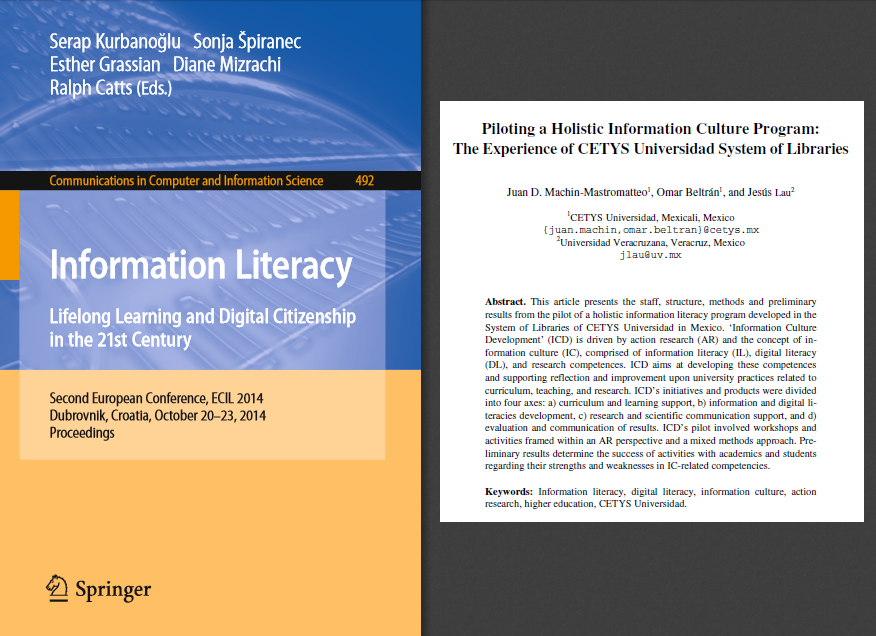
Piloting a holistic information culture program

ECIL2014

Abstract: This article presents the staff, structure, methods and preliminary results from the pilot of a holistic information literacy program developed in the System of Libraries of CETYS Universidad in Mexico. ‘Information Culture Development’ (ICD) is driven by action research (AR) and the concept of information culture (IC), comprised of information literacy (IL), digital literacy (DL), and research competences. ICD aims at developing these competences and supporting reflection and improvement upon university practices related to curriculum, teaching, and research. ICD’s initiatives and products were divided into four axes: a) curriculum and learning support, b) information and digital literacies development, c) research and scientific communication support, and d) evaluation and communication of results. ICD’s pilot involved workshops and activities framed within an AR perspective and a mixed methods approach. Preliminary results determine the success of activities with academics and students regarding their strengths and weaknesses in IC-related competencies.

Full text at Springer Link

Open Access version (Coming soon!)

Recommended reference: Machin-Mastromatteo, J.D., Beltrán, O. and Lau, J. (2014). Piloting a holistic information culture program: The experience of CETYS Universidad System of Libraries. Information Literacy: Lifelong Learning and Digital Citizenship in the 21st Century; Communications in Computer and Information Science, 492, 350-360. http://dx.doi.org/10.1007/978-3-319-14136-7_37

Thinking outside of literacy

thinking outside

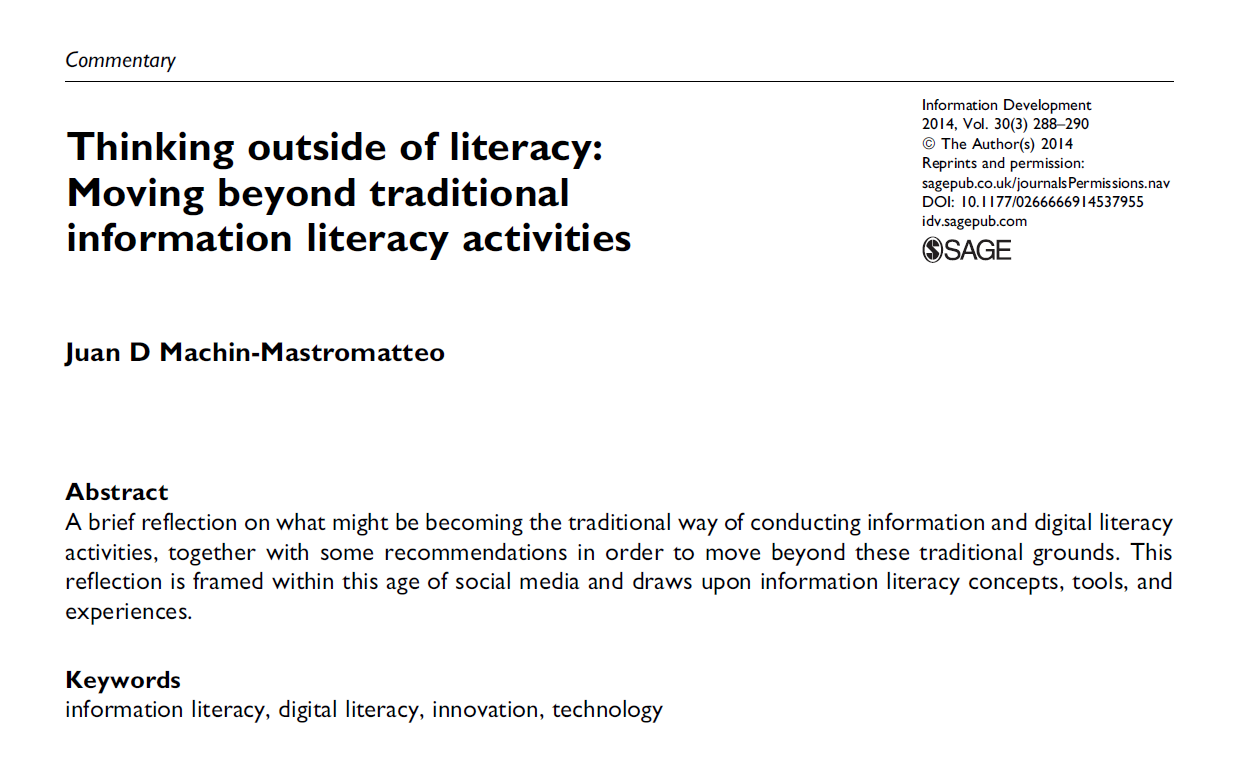
On July 23 2014, I published a commentary in the academic journal Information Development (published by Sage), titled Thinking outside of literacy: Moving beyond traditional information literacy activities. This reflection is framed in the field of information literacy, a dynamic area of practice and research that is typical of Library and Information Science, which contains the competences to access, use and evaluate the information effectively. This field also includes the use of information and communication technologies and participatory media such as social media.

This text offers some suggestions from my practical and research experiences in order to foster a professional reflection upon how we can overcome from these traditional ways of conducting information literacy activities; which are vital for developing an information culture, for university environments as well as for society.

I include the necessary discussion of the differences between the so-called digital natives and the generations preceding them; both have different challenges when they need to use information and technologies  strategically and especially for purposes beyond communication and entertainment. I also mention the recent challenge that I call the ‘ready-made information culture’, a term inspired in the dark side of social media and the over-simplification of the information that we currently consume. This challenge entails the difficulty to reason and think critically over complex and lengthy information; thus implying loses over their messages and resulting counterproductive for the development of critical thinking in the academic sector. Lastly in this discussion, I categorize in two main areas what I call the traditional way of developing information literacy competences:

a) Resource specific training: are basically software demonstrations, very common in libraries when we train users about the use of a technology or an information resource. Its problem is that it seems difficult to keep it dynamic for students, if it is not possible to add a practical component, such as doing problem based learning.

b) Theoretical teaching of information skills: these appear in some international standards and curricula that do not usually specify how do these competences apply to areas of the human or professional profiles that is to be developed. Their challenge is that the student and even the teacher will not necessarily going to understand how to transfer these competences to academic or life scenarios.

These criticisms do not mean to say that these variations of methods to develop information competences are wrong. Conversely, we the teachers must consider both and seek for a third way that integrates the previous two while we discover how to get beyond. It is important to keep at hand these kinds of reflections about how to develop an information culture in our students (and thus these transfer to society) and above all: to discuss them.


Abstract: A brief reflection on what might be becoming the traditional way of conducting information and digital literacy activities, together with some recommendations in order to move beyond these traditional grounds. This reflection is framed within this age of social media and draws upon information literacy concepts, tools, and experiences.

Full text at Sage Publications

Open Access version

Recommended reference: Machin-Mastromatteo, J. D. (2014). Thinking outside of literacy: Moving beyond traditional information literacy activities. Information Development, 30 (3), 288-290. http://dx.doi.org/10.1177/0266666914537955

Slidecasts to be (killed) Discontinued

Slideshare

After the turn of the year, on February 7, Slideshare announced through its blog that slidecasts are going to be discontinued. Slidecasts are presentations uploaded to Slideshare that are synched to a MP3 audio file. While it’s relatively easy to create a slidecast, it may be seen as a niche practice, as some preparation and technical expertise is needed to do it, let alone the fact that Slideshare must be a niche social media site. For example, I used to do the presentation either with Powerpoint or Keynote and then record and edit its corresponding audio with Audacity or Soundforge. Hence, I suppose that only a limited number of Slideshare users have actually created this type of resource.

However, any way I see this decision from Slideshare, I call it a mistake similar to that of Google with its Google Reader (RIP), when they attempted to destroy RSS and the blogosphere to favor a lesser service/technology such as Google+. Of course, this decision is theirs to make, as it’s their service and, like me, most users are likely to use a free account. Even so, I can’t help but think that users of social media sites should have some stake in these types of decisions. I think this particular action from Slideshare is wrong because:

  • Slidecasts have way more views than the presentations without audio: although my presentations have a quite low profile compared to those of other users, my normal  presentations use to have hundreds of views while my slidecasts have thousands of them. I believe that is that shows the impact this advanced function may have. I think while static presentations are decentlly viewed, the amount of views slidecasts get show that they were a powerful type of media, not offered by any other social media site. This takes me to my other argument why this is a mistake.
  • Slidecasts are (were) one of the best and unique Slideshare features, if not the most unique. I understand that by killing it they might be killing the service altogether.

For me the most unsettling part of Slideshare’s announcement is that they state they are going to focus their energy instead “on building new and innovative ways for our users to share presentations”. I don’t want to be skeptic about innovating in social media but I wonder, is that even possible from the point of view of Slideshare, or is this just a sad excuse? You can already share presentations with your other social sites and embed any presentation on any site with an html string.

Since February 28 you’re not able to create new slidecasts. You have until April 30 to download yours and not lose them. What options do we have to cover this absence? By now, I’m thinking of downloading the existing slidecasts I have and uploading them to YouTube and doing future ones using Camtasia or Captivate, although as you may be guessing after reading this post, I’m not very comfortable with the idea of giving more of my content to Google. In any case, I would recommend that you check out Slideshare blog and take a look at the post and the comments. Take a stand, if you liked slidecasts.

Venezuelan proverbs: Uncertainty

There are moments in our existence when we find ourselves hopelessly at a crossroad. In these moments common sense or any kind of clairvoyance is useless to know what will happen. Moments that fill with uncertainty because we don’t often have the power to influence on the development of different situations, and on occasions one way or another depend on the good or bad will of third parties. However, we can find comfort by saying: “The sun will rise and we’ll see, said the blind man”.

Los números de 2013

Los duendes de las estadísticas de WordPress.com prepararon un informe sobre el año 2013 de este blog.

Aquí hay un extracto:

Un teleférico de San Francisco puede contener 60 personas. Este blog fue visto por 440 veces en 2013. Si el blog fue un teleférico, se necesitarían alrededor de 7 viajes para llevar tantas personas.

Haz click para ver el reporte completo.

Articles for the European Conference on Information Literacy (ECIL 2013)

ECIL 2013

The first European Conference on Information Literacy (ECIL) took place on 22-25 October 2013, in Istambul, Turkey. I proposed two papers for this conference and I had the opportunity to get both accepted. This was an important milestone in my career to have two papers selected for the same conference, among the quite impressive sample from Iberoamerican works, Alejandro Uribe Tirado counted 23 contributions, in a conference with an European focus. Athough I could not attend the conference, both these papers were presented by my coauthors and they got published by Springer in the conference proceedings ‘Worldwide Commonalities and Challenges in Information Literacy Research and Practice’. In the following paragraphs you will find the information of both articles and some bullet points about them.

9783319039183

1. Machin-Mastromatteo, J., Lau, J., Virkus, S. (2013). Participatory action research and information literacy: Revising an old new hope for research and practice. Worldwide Commonalities and Challenges in Information Literacy Research and Practice: Communications in Computer and Information Science, 397, pp. 48-53. http://dx.doi.org/10.1007/978-3-319-03919-0_5

  • Slides available!
  • Open access version
  • Tracks and rebuilds a research agenda integrating information literacy with participative methodologies (E.g. action research).
  • It deals with some topics that are also dealt with on my own PhD research, although on a meta level
  • Develops and presents a questionnaire for worldwide experts that is being answered at this moment. You can still answer this questionnaire and share it with your colleagues!
  • It studies the future contributions of this perspectives for the advance of information literacy
  • Sheila Webber wrote a nice post about this research on her blog, thanks!

2. Machin-Mastromatteo, J., Virkus, S. (2013). Doing Online Relearning through Information Skills:  A Mutual Shaping Perspective for Information Literacy Research and PracticeWorldwide Commonalities and Challenges in Information Literacy Research and Practice: Communications in Computer and Information Science, 397, pp. 380-385. http://dx.doi.org/10.1007/978-3-319-03919-0_50

  • Slides available!
  • Open access version
  • It’s part of my PhD research, it integrates social media in a learning experience, discovering the role of information literacy in such integration.
  • The research and methodological framework ‘Doing Online Relearning through Information Skills’ is presented.
  • It advances a conceptual, epistemological and methodological understanding that is important for online learning activities.
  • This particular article discusses the conceptual idea of mututal shaping in this research

International Colloquium on Alternative Models of Learning and Access

Coloquio

On September 19, 2013, CETYS Universidad hosted the International Colloquium ‘Higher Education: Alternative Models of Learning and Access’ and I had the opportunity of moderating its second panel ‘How to successfully swim in learning new schemes Info – skills, MOOCs, ICT and other technologies’. I dedicated some words of introduction to this interesting topic from my perspective as a librarian and as an academic and I also presented the panel’s speakers: Alison Hicks and Jesús Lau.

I wanted to share with you some of my notes of introduction to this session:

  • Although my background is in Library and Information Science, I have been interested in technology and education since I graduated from my bachelor studies on Librarianship, as you may see if you read this blog. I have not been able to study or use Massive Open Online Courses (MOOCs), although they are perhaps one of the most important conceptual and technological innovations regarding alternative models of education.
  • MOOCs are massive, imagine having hundreds or thousand of students; they are open, as they follow the philosophy of openness; and they are online, after all they are courses, online courses.
  • MOOCs are quite interesting as an alternative model, as they may provide universal access to the university, which might have lost its way regarding its uni prefix.
  • I see that MOOCs have plenty of opportunities and challenges for those teaching them and learning from them, some of them have to do with the competences individuals must develop to deal with them, to develop a strong discipline when it comes to study and for managing one’s own time.
  • Information and digital literacies play a very important role when dealing with MOOCs as well as processes of academic certification and rigor, which acquire a new and perhaps more demanding dimension because MOOCs differ a great deal from classic courses.
  • I believe MOOCs must be oriented and grounded on research and problem solving assignments, and that takes a very special academic to lead them. A special type of course needs special teachers and special students and they can be taught special competences for dealing with them. Training would involve various university departments, such as research, the academia, and the university libraries.
  • It is interesting to point out the importance of the focus of this panel, where we have two librarians as guest speakers, Jesús Lau and Alison Hicks, as well as myself, the Learning and Information Development Librarian of CETYS Universidad, having the honor of introducing the topic in discussion and our distinguished guests. I believe that this configuration of speakers is quite a statement from CETYS’ part, because it means that libraries and librarians must be integrated as part of the engine of educational innovations. One clear path to follow is through information and digital literacies but we must question and enhance libraries’ role in breaking educational ground.

You can take a look at the whole session, which was recorded. I also prepared a Spanish/English bibliography on MOOCs, higher education and skills for this Colloquium.

Surface Pro 2 and Surface 2: Now With New Kickstand!

kickstandThis is a parody (of course) of a post with the same title via Slashdot

Venezuelan proverbs: dealing with the contempt from those who don’t know you

This Venezuela proverb came to mind many months ago, while we were living in a far and inhospitable country of the far south of Latin America and it was time to write it down here.

In my homeland, we use to say this proverb, “no one can say you didn’t dance” when we have to deal with other people underestimating us or showing us contempt, usually at a professional level. These negative attitudes toward us may be motivated because they don’t know anything about us (nor they want to), because of jealousy, selfpreservation instinct or even envy of our features. What “you danced” refers to all experiences and knowledge that we have gathered along the way, no matter if they are empirical or formal. For example, if anyone underestimates our expertice (which we have) at the moment of applying for a job and the result is that we are discarded for a mere whim instead of an objective assessment, we should not despair, because we know that we know, we know that we are capable and we can prove it, because no one can say you didn’t dance!

Original: “Nadie te quita lo bailao”

English equivalent: “No one can say you didn’t dance”