2012 in review

The WordPress.com stats helper monkeys prepared a 2012 annual report for this blog.

Here’s an excerpt:

The new Boeing 787 Dreamliner can carry about 250 passengers. This blog was viewed about 1,200 times in 2012. If it were a Dreamliner, it would take about 5 trips to carry that many people.

Click here to see the complete report.

Course ‘Managing and running information and digital literacy projects for libraries and archives’ (2nd edition)

From December 10 to 14, between 11:00 and 15:00. (Mexico time) I will be delivering the second edition of the online course ‘Managing and running information and digital literacy projects for libraries and archives’ (in Spanish, sorry, but you may hire me for an English version!), through the online training system of Información Científica Internacional (ICI).

This course is excellent for library and archives professionals whom wish to know more about the topic or whoever wants to develop a literacy initiative but doesn’t know where to start. It is also good for those who have worked with literacy and wish to revise and improve their projects. During the course we will be following a methodology which will take us step-by-step throughout the design of a literacy project, considering the structure, pedagogies, resources, among many others.

You can check out the promotional slides, which include results and impressions from participants of the first edition of the course (in Spanish only for now, sorry again!)

How to raise and develop a librarian

Published originally by InfoTecarios

Introduction

This post emerges from a question that Julián Marquina made on Facebook: how to make his little daughter to understand the word “No”. After answering something, I realized that I have plently of experience as a mother, something around thirthy years, and that tumbling and not always spot-on I can give today some “instructions” on how to raise a librarian. Together with my experience as a mother, I have also collaborated in the formation of 21 generations of venezuelan librarians. This is why this post is inspired by Julián, to whom I thank and as a homage to my ex-students and my “favorite colleague”, Juan Daniel, with whom we have had agreements and disagreements and from whom I am very proued as a mother, as teacher and professional.

Intructions for before childbirth

For this period, it is very important that the mother works at a library. I am sorry if the fathers are feeling left out. In this case, the mother will no longer work alone but in company “from the inside”. It is something quite peculiar this feeling of being in company all the time, it is like you can take on the whole world. I was studying architecture and the need for having a job took me to the Library of the Faculty of Architecture. This is how we, Juan Daniel and I, discovered together the wonderful world of libraries. Not only attending the users, but also diving for the first time into cataloguing and classification. How was that possible? The director of the library, Carmencita Bigott, quite a character in the field, somehow saw our vocation towards library tasks. In the same way, Juan Daniel and I had our first experiences in academic libraries.

It also helps that the baby listen to short stories before birth, which can also develop since the infancy an affinity for writing, and the possibility to win literary contests. Related to this, a particular poem by Juan Daniel, “La lluvia” (The Rain) had the particularity that when read by him in public, it would turn any sunny day into rain. Although you may not believe this, it is also good to sing to them, in my case they were songs by Miguel Bosé, and yes, I admit it, I still like his music a lot. Sitting in the hospital bed, waiting for the time of childbirth, the two of us alone, singing: “te amaré, te amaré” (I will love you)…

The child has born, now to continue development…

I did not have anyone to take care of him, so from his first days of life he went with me to work in the library. In a long shift you have to divide time, between the carriage, a blanked in the middle of some books, or in the secretary’s lap. With the baby carriage we catalogued and classified, we sought for books and we put them back in the shelves. Some day, he was in the blanket when a professor came and he was in awe to see a baby, awaken and not making any noise. Of course, it is important to keep quiet in the libraries… Shhhhh! With the secretary, Juan Daniel wrote his first library cards. We made several tests and we could verify that the last thing he always did was to write a period (.), even when we asked him to keep writing.

In the first years it is very important to read for them everyday. Many, many short stories, every day, some days more than once. The child responds with surprise to each reading as if it were the first time. In this way, “Where is Spot?”, a short story about a mother dog searching for her cub all over the house, became quite an adventure. Books with records, in that age of vinyl, such as Winnie the Pooh: “I am not disguised as a cloud, I am not a very chubby bear” or similar, could be the first songs of your “librarian cubs”. In that moment even the music for children can be useful for the child to be creative, take a mic and roleplay the circus, etc., or running from one side to the other singing Don Diablo: “Ron con cocacola”…

The short stories that my father used to tell him were also helpful. I have no idea how they were, in my times they were of “Pepín y Don Paquito and Pastrafulata the witch”. Do not believe me, but it is also important to give your child a wall to paint, to let them tape “The Smurfs”, to draw and to write short stories. Before they learn to write we should perform the task of writing the text of their stories, while they narrate them out loud and illustrate them.

The last school years

It is for sure that, as mother, student, and professional you would need help to organize some library. If we remember that the boy could write library cards since he was a baby, now I could propose some business to him: while you classify, catalog and input the documents into the database, your son could -for an attractive fee- could write the labels and paste them on the books. We see graciously how our children come to tell us that a certain book should not be into classified within a certain number or with a certain cutter code. But that is how life is, we see with pleasure how our children learn day by day and we look forward for them to go beyond than us.

In high school

The library of the Faculty of Humanities was migrating their catalogs to a database when Juan Daniel was studying his last high school years. It was necessary to form a team to transcribe their collection in the holiday season. Given the fact that our boy had experience enough, he could be part of such team, integrated by professors and students from the School of Librarianship. This endeavor was a success and it was difficult to play to compete with him.

A difficult choice: to study librarianship

I do not recommend the academic aptitude tests conducted in high schools. Juan Daniel was as capable to be an engineer as a fashion designer, something that does not help a boy of 16 years old to choose his career. It is true that you should not interfere in those matters, it is overkill to say that he has “a certain affinity” with libraries, books, and writing. His poems are very good, he could have studied literature, but as I said in that opportunity, you have to live from something. I know, mothers are horrible!

So he entered the School of Librarianship occupying the 5th place in the admission test and I found him and a hundred more students in class. My usual question, ‘all those who did not want to study librarianship, please raise your hand’. More than half of the classroom, including Juan Daniel, raised their hands. Quite frankly, I told them that my wish in that moment was to escape, but that instead, I took on the challenge of developing very good librarians, with the same love as I towards the career. That semester was quite the challenge, my son was among those who did not want to do it…

Today many of them are information professionals, some have done postgraduate studies in the field or studied other careers. Many of my ex students show everyday that they are very good professionals. Some of them are dedicated to theater, fashion design or sales, I think that being librarians has been a good life experience for them, they are good people, they love reading and books. Juan Daniel has been one of my best students. I cheated, I was much more demanding with him than with his classmates, but I had to do it. The things had to be more difficult for him. Regardless, he chose to take the courses with his demanding teacher. In many occasions we had the chance to work together, an awesome team. But I also saw him grow as a professional, to work on his own and going to study in Europe.

As a manner of conclusion

Up until this point you would like to know the end of this story, but it is not over yet. Juan Daniel has a master and he is finishing his PhD. In some days he will reunite with his mother again, now in a new country, where many things might happen. That little thing who danced and sang, who told short stories and made circus functions is on my memory and in my heart. Today he is married, he offers courses and conferences, write books and loves his career. The merit is all his and I as his mother, happy and proud.

I hope that these “instructions” to raise and develop a librarian may be useful. Of course, they do not always work. In my case, I also have a daughter who is an illustrator, but it is not far from our field. Regardless, what is important is that they are good people.

Estela Mastromatteo @emastromatteo

An approximation to the new competencies of the librarian, presentation in Chapingo (Mexico)

I received a very kind invitation from a Mexican colleague to participate with a conference in the 3rd National Encounter and 1st International of Librarians in the Autonomous University of Chapingo (Mexico). On the October 4th and via Skype, I made my intervention titled “An approximation to the new competencies of the librarian”, which was some kind of summary of the keynote I delivered for the 3rd Conversation with librarians, bibliophiles and archivists. At the same time, this is part of some research I am conducting in parallel to my main research on the integration and mutual shaping of social media, higher education and information literacy.

With these working documents, I attempt to research on the new competencies and new roles that us librarians and related professionals are developing and fulfilling in the last few decades. We can take a work such as this in order to:

  • Reflect upon our practices
  • Rethink our roles
  • To seek diverse and novel offers of professional and lifelong training
  • To develop these new competencies and roles
  • and finally innovate on library services

I have uploaded the slides with their audio incorporated and the full text article (in Spanish).

DORIS at Library 2.012

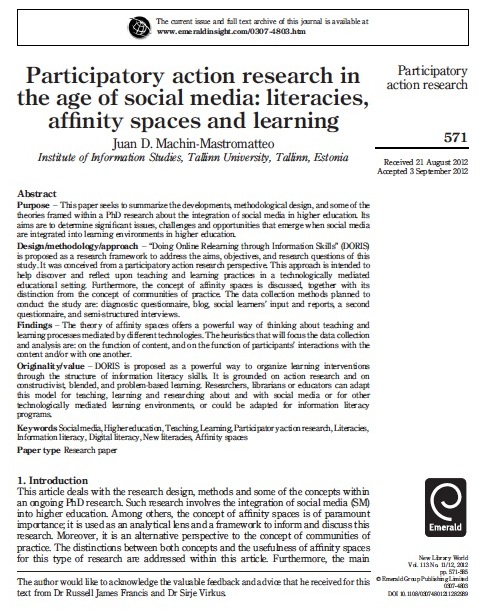
I will be presenting my doctoral research on the (free) Worldwide Virtual Conference Library 2.012. The presentation name is “Doing Online Relearning through Information Skills (DORIS): Contributions for Information Literacy Programs”. This research in a nutshell is about the integration of social media into higher education and the discovery of the roles that information, digital and new literacies play in such integration. This presentation focuses on the contributions that my research can provide to information literacy programs. You may find information about my session and the schedule of the conference according to your timezone.

I offer you the slides, the link to the recording of my session, as well as the audio file. Cheers!

Present at the IV Latinamerican Encounter of Librarians, Archivists and Museologists (EBAM)

I arrived at Buenos Aires, where I will present my PhD research for the first time in Spanish at the IV Latinamerican encounter of librarians, archivists and museologists (EBAM). My presentation was called (translated) “Doing online relearning through information skills (DORIS): Contributions for social research, information literacy programs and pedagogies”. This was an excellent opportunity of presenting my research in Spanish for the first time with my return to Latin America. Very nice to do this in a regional conference that gathered professionals from these three related fields.

In the presentation, I reflected upon the origin of this research: a) as an extension of the emerging topic from my master thesis about the use of social media for ‘serious’ purposes and b) as a return or combination with my previous research interest: information literacy.

I offer this research as a contribution to the understanding about the use of technology for higher education. Moreover, provide pedagogical contributions for information professionals wishing to expand upon them, because we librarians and related professionals are not prepared for this role in our typical curricula. It is important to highlight that in order to develop a good information literacy program and to continue following our new role of teachers or instructors, we need to: 1) a sound structure to develop such programs and 2) to develop pedagogic skills.

The slides and the full text are in the Spanish version of the blog, in Spanish, of course.

And here is a picture with Mafalda!! 😀

DORIS at Learning 2.0

I will be presenting my doctoral research on the (free) Worldwide Virtual Conference Learning 2.0. The presentation name is ” Doing Online Relearning through Information Skills (DORIS): Using social media in higher education”. This research in a nutshell is about the integration of social media into higher education and the discovery of the roles that information, digital and new literacies play in such integration. This presentation focuses on the contributions that my research can provide to pedagogies involving the use of technology, specifically social media. You may find information about my session here.

I give you the slides, the link to the recording of my session, as well as the audio file.

Course ‘Managing and running information and digital literacy projects for libraries and archives’

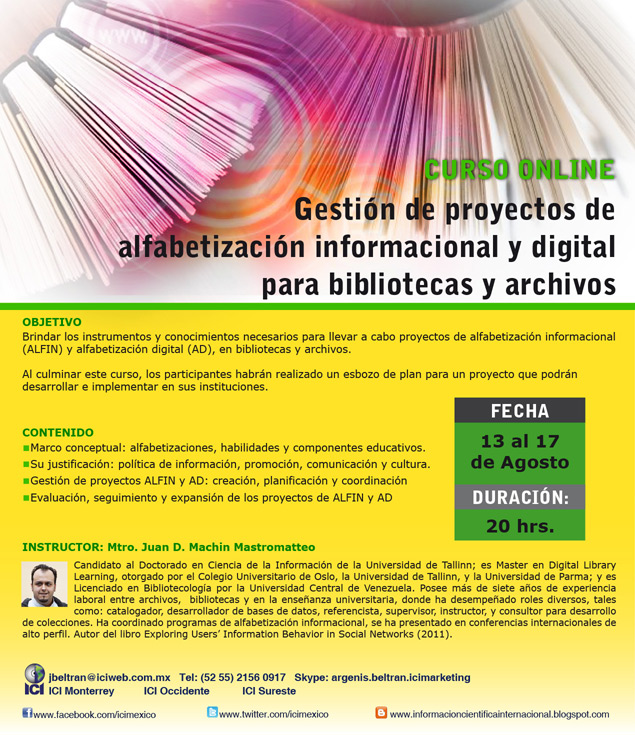
In August 13-17 2012, I delivered a first edition of the online course ‘Managing and runing information and digital literacy projects for libraries and archives’ (in Spanish), through the online training system by Información Científica Internacional.

This is a great chance to bring back to Latin America the knowledge I have gathered during my studies and professional activities in Europe.

Venezuelan Proverbs: for someone pointing out a defect you both have

This Venezuelan proverb, one of my absolute favorites, is for those cases when someone is pointing out a defect you both have, or he/she is telling you something they have no business or moral authority for saying it. It is a wonder that an equivalent to this proverb do exist in English, so I will put the original in Spanish (involving two animals with shells), its translation, and the English language equivalent.

Original: “Cachicamo diciéndole a morrocoy conchúo”

Translation: “The armadillo calling the red-footed tortoise shelled”

English equivalence: “The pot calling the kettle black”

Libraries & Information in Media: The Daily Planet (as in Superman: Earth One)

Superman: Earth One (2010) represents a re-imagination of Superman’s origin story. Written by the author of Babylon 5, J. Michael Straczynski, it is set in the time when Kal-El leaves Smallville to go to Metropolis. I find some elements of his take more believable (yes, I know the idea of a Superman is not so believable). For example, when Kal-El’s ship crashes, the Kents of course find it, but there is a shady organization looking for the object that crashed, which they retrieve and keep looking for its occupant. This graphic novel has some of the qualities I expected from Straczynski, as with Babylon 5, he delivers an engaging, interconnected and entertaining story. Although I expected more. Perhaps Superman fans would enjoy it more than I did, as I’m a Batman guy. But enough background. In order for this to fit in this section of the blog, I wanted to point out some things related to libraries and information present on this piece of media, in this case: its portrayal of some issues around the Daily Planet (Metropolis’ newspaper), which is journalism. Ah, journalism.

It’s funny to note that although Perry White (editor of the Daily Planet) advices Lois Lane to “write about what you are writing about, not about you writing about what you are writing about”, what we see in her enclosed pages of the Daily Planet is the latter. I think this was either a bit silly, or very faithful to her character, as she often gets away with being a smart-ass. Lois displays some soul on her writing, but White also advices to use soul on news writing, so I don’t find this very congruent within all his recommendations. Because, is it ‘writing about you writing about what you are writing about’, putting some soul into your writing? (See the last part of this post, where I write about this issue further).

Jimmy Olsen seems to be taking at least 12 megapixel pictures, hence, ‘chocking the server with the files’. Shouldn’t a newspaper have a better server? If the server chocks with a picture, what would happen with regular, worldwide traffic? Perhaps a 20 Mb picture is not good for a printed black and white newspaper, but we see in the enclosed Daily Planet pages that you ‘may find more about on dailyplanet.com’. It would have been very clever for White to point out that these pictures are good for the website version of the paper, but advice him to crop them for the print version, put them on a grayscale, or something. This might be extreme librarian nitpicking, but ‘the devil’s on the details’.

Now the most serious stuff, and I must cite White more extensively as he states “Thanks to the Internet, every yahoo with a keyboard thinks that just because he can type, he can write, as for you [referring to Clark] look, I read your articles, and they are fine, but nothing special. A good writer writes from his soul. You write like you’re holding something back.” I find his two statements about Internet journalism and writing from his soul, not too congruent between them. Furthermore, they are not congruent with the guidelines given to Ms. Lane. Firstly, his position towards Internet journalism is very understandable, coming from an editor for a ‘Big and Old Media’ device. Although showing perhaps too much contempt for an alternative journalism that is becoming more and more valid everyday, this adds to his character. But it’s a worn out and expected discourse from an old business model perspective. We see traditional media, or as I like to call ‘Big and Old Media (BOOM)’ as failing to inform, to entertain, and let alone: educate. Fox News anyone? We see a highly sensationalist BOOM, one that miserably copies models from new media in order to keep being pertinent (SMS, social media integration or attempts to do so). And we see BOOM giving wrong publicity through their misguided scandals regarding videogames (for example the case of Rapelay, or P2P technology). These scandals create the wrong effect, instead of raising conscience or awareness towards and issue, they promote it through scandal and sensationalism. Thus turning low profile and extinct topics into high profile, blown out of proportion problems. So, perhaps BOOM exhibits too much soul, or no soul at all by doing these things. Apart from this, BOOM is against soul, against personal perspectives, or it displays too much of it, it’s not a consistent criteria, being in news or scholarly/scientific communications. New media on the other side, has a personal commitment and often a disregard for corporate or financial interest within its content. Moreover, it has crowds approving or disapproving, and adding value to the information. Is this not better? Who knows…