How to raise and develop a librarian

Published originally by InfoTecarios

Introduction

This post emerges from a question that Julián Marquina made on Facebook: how to make his little daughter to understand the word “No”. After answering something, I realized that I have plently of experience as a mother, something around thirthy years, and that tumbling and not always spot-on I can give today some “instructions” on how to raise a librarian. Together with my experience as a mother, I have also collaborated in the formation of 21 generations of venezuelan librarians. This is why this post is inspired by Julián, to whom I thank and as a homage to my ex-students and my “favorite colleague”, Juan Daniel, with whom we have had agreements and disagreements and from whom I am very proued as a mother, as teacher and professional.

Intructions for before childbirth

For this period, it is very important that the mother works at a library. I am sorry if the fathers are feeling left out. In this case, the mother will no longer work alone but in company “from the inside”. It is something quite peculiar this feeling of being in company all the time, it is like you can take on the whole world. I was studying architecture and the need for having a job took me to the Library of the Faculty of Architecture. This is how we, Juan Daniel and I, discovered together the wonderful world of libraries. Not only attending the users, but also diving for the first time into cataloguing and classification. How was that possible? The director of the library, Carmencita Bigott, quite a character in the field, somehow saw our vocation towards library tasks. In the same way, Juan Daniel and I had our first experiences in academic libraries.

It also helps that the baby listen to short stories before birth, which can also develop since the infancy an affinity for writing, and the possibility to win literary contests. Related to this, a particular poem by Juan Daniel, “La lluvia” (The Rain) had the particularity that when read by him in public, it would turn any sunny day into rain. Although you may not believe this, it is also good to sing to them, in my case they were songs by Miguel Bosé, and yes, I admit it, I still like his music a lot. Sitting in the hospital bed, waiting for the time of childbirth, the two of us alone, singing: “te amaré, te amaré” (I will love you)…

The child has born, now to continue development…

I did not have anyone to take care of him, so from his first days of life he went with me to work in the library. In a long shift you have to divide time, between the carriage, a blanked in the middle of some books, or in the secretary’s lap. With the baby carriage we catalogued and classified, we sought for books and we put them back in the shelves. Some day, he was in the blanket when a professor came and he was in awe to see a baby, awaken and not making any noise. Of course, it is important to keep quiet in the libraries… Shhhhh! With the secretary, Juan Daniel wrote his first library cards. We made several tests and we could verify that the last thing he always did was to write a period (.), even when we asked him to keep writing.

In the first years it is very important to read for them everyday. Many, many short stories, every day, some days more than once. The child responds with surprise to each reading as if it were the first time. In this way, “Where is Spot?”, a short story about a mother dog searching for her cub all over the house, became quite an adventure. Books with records, in that age of vinyl, such as Winnie the Pooh: “I am not disguised as a cloud, I am not a very chubby bear” or similar, could be the first songs of your “librarian cubs”. In that moment even the music for children can be useful for the child to be creative, take a mic and roleplay the circus, etc., or running from one side to the other singing Don Diablo: “Ron con cocacola”…

The short stories that my father used to tell him were also helpful. I have no idea how they were, in my times they were of “Pepín y Don Paquito and Pastrafulata the witch”. Do not believe me, but it is also important to give your child a wall to paint, to let them tape “The Smurfs”, to draw and to write short stories. Before they learn to write we should perform the task of writing the text of their stories, while they narrate them out loud and illustrate them.

The last school years

It is for sure that, as mother, student, and professional you would need help to organize some library. If we remember that the boy could write library cards since he was a baby, now I could propose some business to him: while you classify, catalog and input the documents into the database, your son could -for an attractive fee- could write the labels and paste them on the books. We see graciously how our children come to tell us that a certain book should not be into classified within a certain number or with a certain cutter code. But that is how life is, we see with pleasure how our children learn day by day and we look forward for them to go beyond than us.

In high school

The library of the Faculty of Humanities was migrating their catalogs to a database when Juan Daniel was studying his last high school years. It was necessary to form a team to transcribe their collection in the holiday season. Given the fact that our boy had experience enough, he could be part of such team, integrated by professors and students from the School of Librarianship. This endeavor was a success and it was difficult to play to compete with him.

A difficult choice: to study librarianship

I do not recommend the academic aptitude tests conducted in high schools. Juan Daniel was as capable to be an engineer as a fashion designer, something that does not help a boy of 16 years old to choose his career. It is true that you should not interfere in those matters, it is overkill to say that he has “a certain affinity” with libraries, books, and writing. His poems are very good, he could have studied literature, but as I said in that opportunity, you have to live from something. I know, mothers are horrible!

So he entered the School of Librarianship occupying the 5th place in the admission test and I found him and a hundred more students in class. My usual question, ‘all those who did not want to study librarianship, please raise your hand’. More than half of the classroom, including Juan Daniel, raised their hands. Quite frankly, I told them that my wish in that moment was to escape, but that instead, I took on the challenge of developing very good librarians, with the same love as I towards the career. That semester was quite the challenge, my son was among those who did not want to do it…

Today many of them are information professionals, some have done postgraduate studies in the field or studied other careers. Many of my ex students show everyday that they are very good professionals. Some of them are dedicated to theater, fashion design or sales, I think that being librarians has been a good life experience for them, they are good people, they love reading and books. Juan Daniel has been one of my best students. I cheated, I was much more demanding with him than with his classmates, but I had to do it. The things had to be more difficult for him. Regardless, he chose to take the courses with his demanding teacher. In many occasions we had the chance to work together, an awesome team. But I also saw him grow as a professional, to work on his own and going to study in Europe.

As a manner of conclusion

Up until this point you would like to know the end of this story, but it is not over yet. Juan Daniel has a master and he is finishing his PhD. In some days he will reunite with his mother again, now in a new country, where many things might happen. That little thing who danced and sang, who told short stories and made circus functions is on my memory and in my heart. Today he is married, he offers courses and conferences, write books and loves his career. The merit is all his and I as his mother, happy and proud.

I hope that these “instructions” to raise and develop a librarian may be useful. Of course, they do not always work. In my case, I also have a daughter who is an illustrator, but it is not far from our field. Regardless, what is important is that they are good people.
Estela Mastromatteo @emastromatteo

An approximation to the new competencies of the librarian, presentation in Chapingo (Mexico)

I received a very kind invitation from a Mexican colleague to participate with a conference in the 3rd National Encounter and 1st International of Librarians in the Autonomous University of Chapingo (Mexico). On the October 4th and via Skype, I made my intervention titled “An approximation to the new competencies of the librarian”, which was some kind of summary of the keynote I delivered for the 3rd Conversation with librarians, bibliophiles and archivists. At the same time, this is part of some research I am conducting in parallel to my main research on the integration and mutual shaping of social media, higher education and information literacy.

With these working documents, I attempt to research on the new competencies and new roles that us librarians and related professionals are developing and fulfilling in the last few decades. We can take a work such as this in order to:

  • Reflect upon our practices
  • Rethink our roles
  • To seek diverse and novel offers of professional and lifelong training
  • To develop these new competencies and roles
  • and finally innovate on library services

I have uploaded the slides with their audio incorporated and the full text article (in Spanish).

DORIS at Library 2.012

I will be presenting my doctoral research on the (free) Worldwide Virtual Conference Library 2.012. The presentation name is “Doing Online Relearning through Information Skills (DORIS): Contributions for Information Literacy Programs”. This research in a nutshell is about the integration of social media into higher education and the discovery of the roles that information, digital and new literacies play in such integration. This presentation focuses on the contributions that my research can provide to information literacy programs. You may find information about my session and the schedule of the conference according to your timezone.

I offer you the slides, the link to the recording of my session, as well as the audio file. Cheers!

Present at the IV Latinamerican Encounter of Librarians, Archivists and Museologists (EBAM)

I arrived at Buenos Aires, where I will present my PhD research for the first time in Spanish at the IV Latinamerican encounter of librarians, archivists and museologists (EBAM). My presentation was called (translated) “Doing online relearning through information skills (DORIS): Contributions for social research, information literacy programs and pedagogies”. This was an excellent opportunity of presenting my research in Spanish for the first time with my return to Latin America. Very nice to do this in a regional conference that gathered professionals from these three related fields.

In the presentation, I reflected upon the origin of this research: a) as an extension of the emerging topic from my master thesis about the use of social media for ‘serious’ purposes and b) as a return or combination with my previous research interest: information literacy.

I offer this research as a contribution to the understanding about the use of technology for higher education. Moreover, provide pedagogical contributions for information professionals wishing to expand upon them, because we librarians and related professionals are not prepared for this role in our typical curricula. It is important to highlight that in order to develop a good information literacy program and to continue following our new role of teachers or instructors, we need to: 1) a sound structure to develop such programs and 2) to develop pedagogic skills.

The slides and the full text are in the Spanish version of the blog, in Spanish, of course.

And here is a picture with Mafalda!! 😀

DORIS at Learning 2.0

I will be presenting my doctoral research on the (free) Worldwide Virtual Conference Learning 2.0. The presentation name is ” Doing Online Relearning through Information Skills (DORIS): Using social media in higher education”. This research in a nutshell is about the integration of social media into higher education and the discovery of the roles that information, digital and new literacies play in such integration. This presentation focuses on the contributions that my research can provide to pedagogies involving the use of technology, specifically social media. You may find information about my session here.

I give you the slides, the link to the recording of my session, as well as the audio file.

Course ‘Managing and running information and digital literacy projects for libraries and archives’

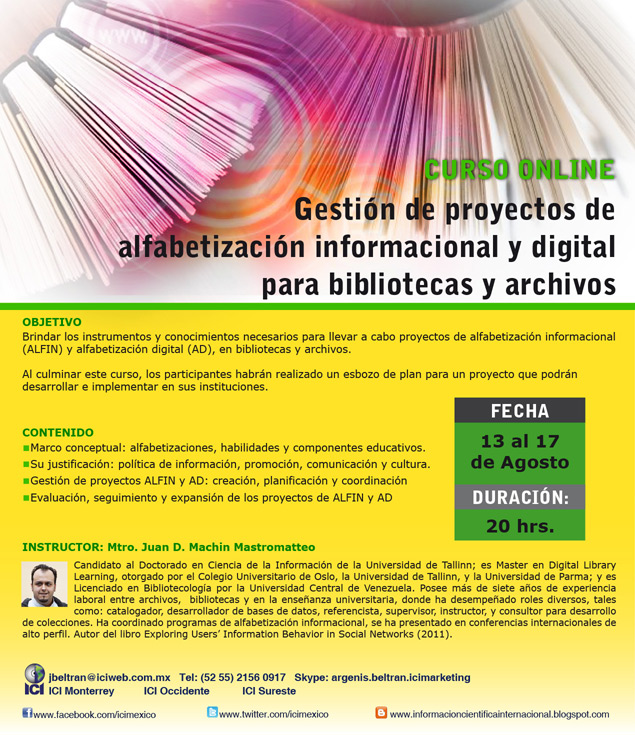
In August 13-17 2012, I delivered a first edition of the online course ‘Managing and runing information and digital literacy projects for libraries and archives’ (in Spanish), through the online training system by Información Científica Internacional.

This is a great chance to bring back to Latin America the knowledge I have gathered during my studies and professional activities in Europe.

On a second half of a course in Gothenburg

This post is a sequel to On a first half of a course in Gothenburg

I came back from the second meeting in Gothenburg for the course on participatory media. It was very nice because I could take Doris with me this time, so she could see a piece of Sweden in person.

I’m really thankful to the University of Gothenburg and all academics associated with this particular course (and another one I took in 2010), as it was the fourth time I went to Sweden for academic affairs and swedes have really made me feel at home, enhancing my motivations to go on, sharing interesting ideas, and overall spending a good time as colleagues.

For this meeting I prepared a paper (which was a little messy) about the concepts of engagement and affinity spaces (James Paul Gee) within my own PhD research. An interesting fact is that I got to meet Etienne Wenger in a seminar in Tallinn University just before leaving for Gothenburg, it was nice to present to him an extremely short overview of my research, however, and perhaps most importantly is that I got his blessing to detach my research from the theory of community of practice and use affinity spaces instead. I mainly decided towards this course of action as Gee really makes good points into when it’s good to go for one or another.

The most promising direction to go with for this course paper, is to further develop this paper with the concept of affinity spaces, which I am doing now. I believe when I’m done I will look to publish it, but more on that later…

Next, I will just share some interesting and disorganized ideas I wrote down during this second meeting:

People lack concepts to describe social media practices, this is pretty evident if you do practice oriented or behavioral research with people on social media or other technological topics. I believe that nearly everything you do with technology tends to be under an automatic “pilot function” of our brains. Perhaps it has to do with the fact that we mostly learn by doing in our connected lifestyles. For example, tell me how do you search for further information for some piece of news you just saw on your social sites… there is no straightforward answer to that, and you might run into more obstacles with one topic than with another. Or for example, speak to me about how you decide to share something with one friend or another, and what is the best way you could do it. This statement relates to my research in some way, and there are two ways to do this research at a conceptual level regarding my interactions with the participants, I can either give no concepts at all and have them explain to the best of their knowledge what they are doing and what are their challenges, and then try to figure out of the data, where do every bit of their answers fit into a conceptual framework. The other direction, which is the one I would take, is to initiate participants to concepts, but not in the sense that they have to accept these concepts. Rather, to mediate them and reach a common understanding with them about the concepts. For example, we need to speak on similar terms about information literacy, digital literacy, and new literacies. I have to figure out where on the Cambridge Companion to Vygotsky is the quote: “concepts are tools to reflect and act”, as none can say it better.

Really funny statement: “KGB style VLEs, as they see data about everything” what can I say? It’s funny that I am meeting people who dislike VLEs (Virtual Learning Environments) aka LMSs (Learning Management Systems) just as me. And I finally found out an article which don’t speak highly of them. I love this quote so much in said article: they “attempt to render the online learning space familiar through a conservative dependence on predigital metaphors.” Apart from the fact that they are basically surveillance systems is the fact that their design is top down, usually made by IT guys who have little or a really huge imagination, often disconnected with any criteria of accessibility, usability, and/or information architecture. Too many clicks, clumsy, labels don’t make sense, all operations are overly redundant…

Another cool quote: “technology is there to suck the information out of us”, this is a very interesting statement about social networking technologies, because really, this technology is put into place to get information from you, everything is based on your real life profile (the use of the real life you is encouraged anyway). Interestingly, and within my research, where I have to discuss on one side the content I organized for the study and the interactions among participants, I find that the difference between content and interactions is very fuzzy when it comes to social media (and by extension a research on social media), you could almost say that one is another! Funny how we could see The Matrix metaphor on Facebook, where you are the product.

Web 2.0 is a technical concept/descriptor which refers more to the technological platform and the technical aspects of the net which makes it 2.0, and this term is less and less visible in the literature. Rather, we can use a wide variety of names, like social media and remix culture, participatory culture, which are more social oriented or content terms.

Remnants of the old media/old culture survive/clash with new media, I have said before – though I’m not sure if in the blog- that this is a very interesting time to live in because of these tensions, among other things of course. More than once we can take a look at how television is trying to be a social media or to emulate web-like devices. When, at the beginning, Youtube was somehow modeled after old media. We can see this tension also looking at the relevance of newspapers and newspaper-like old media in front of news blogs, and specially RSS, which can be tailored to suit any taste. Digital devices which, for many reasons, can be more effective/likeable ways to get your news. Also thinking about this, it’s very interesting as Rick Falkvinge points out the fact that young people “take sharing in the connected world so totally for granted, that they discard any signals to the contrary as ‘old-world nonsense'”

The issue that “educational research doesn’t get done because of the issue of informed consent.” This is a big challenge, of course I’m not saying that you should jump over ethical and privacy considerations. This challenge is present in any kind of research with people, and it’s funny how social science, information science or educational research doesn’t involve any blood sampling or anything, but anyway it’s difficult to get volunteers for it. I know it very well, as some differences of opinion and organizational policies proved catastrophical for my research and delayed it for some months. And it’s something that some of the literature on action research on education talks about: the difficulty to do traditional research from education, the design of research, consent from the participants, to do it without compromising your time as a teacher, the difficulty of documenting it, and let’s not talk about how badly some circles view action research. However, it’s a shame if research in education can’t be done easily, as academia needs to be researched on and renewed. An action research perspective is extremely important, as critical practice leads to understand power and oppression. Perhaps (and I have faith in this) by really telling students what and why you are researching, you will get some students to participate in your studies sooner or later.

If there is informal learning, then there is informal teaching! This was an interesting discussion within the course. If you could learn informally, say, reading Wikipedia articles, then, I believe that for example people guiding others in forums or teaching how to play guitar on Youtube are informal teachers. They are not necessarily doing this while attached to their regular duties within an organization, they are mostly doing this for free, because they like to (or just ’cause). The motivations of these kinds of users might be a very interesting topic to research.

Two distinct narratives regarding the nature of social media, one as a real communication media (different than one way media like TV or Radio), really connecting people, with an emancipatory potential, enhancing and encouraging collaboration and sharing; the other a dark one, being a covert instrument of control and surveillance. Funny though, these two narratives are not mutually exclusive. We can see that, either in eastern and the western countries, governments have been enforcing control (or censorship) over the Internet, over different things, and for many different reasons (Falkvinge summarizes this last point wonderfully) BUT, governments tend to be not as tech proficient as people, and their protection from harm can have serious privacy and ethical implications. Which takes me to the next point.

V for Vendetta, I can’t take it off of my mind when dealing with this topics of control and surveillance, this comic book is perhaps as important for these times as 1984 has been for more than 50 years. Even if V is pre-social media, it’s a great textbook for this age of social media, activism, whistleblowing, Pirate Parties, and the awakening of the people in general.

This got a little too long, what do you think?

3rd Conversation with librarians, bibliophiles and archivists

I participated, with great honor and pleasure, on the 3rd Conversation with librarians, bibliophiles and archivists, which was organized by Doknos in the National Library of Ecuador. There, I presented the keynote conference titled Libraries and Librarians 2.0: Concepts, categorization of their competencies, comments and ideas. You can check the Spanish version of the post to check out the full keynote (in Spanish).


On a first half of a course in Gothenburg

I’m participating in this course about participatory media which brought me for its first half again to the nice city of Gothenburg (Sweden).

It has been very interesting for me to find out that most of my colleagues have a Library and Information Science background and that so many of them are researching the use of social media for educational purposes. I have myself seen this trend to increase in all the international courses and workshops I have attended in the recent years. I think the most important questions posed on this matter within these days are:

  • Why are you doing it?
  • Why does it matter?
  • Which tools are you going to use and why?
  • Philosophical/Epistemological/Theoretical background is extremely complex
  • Of course, you mustn’t ignore that technology is but a tool and does not shape change by itself.
  • The question of how to assess the learning of students is a big question, no easily answerable. It’s one of my concerns in my study, although is not one of the important ones.

I was curious that one colleague is studying the divide between the social media and the real world within a higher education environment, as myself I found in my research that you could have pretty opposite opinions on it from the students “suffering” with these experiments that we researchers do. On one side I have seen that it has been very positive as in such a way that students have told me that they didn’t think about using social media in education before (young participant), that it’s inspiring in a way to enrich his own practice (senior participant); and on the other side, one student (young participant) getting really pissed off because I sent all participants a message about our activities through Facebook’s private messaging system.

Also of note, was the “scientific dinner”, meaning a dinner where colleagues and senior professors gather and speak about research, and well, of course some miscellanea and jokes. I kind of miss that… In any case, I am very happy and grateful to have the opportunity to meet my international peers and have this kind of exchange. It’s incredibly helpful.

I was very glad that after the short presentation of my research I got some of the few and nice words I have myself received towards my choice of research method: Participatory Action Research. Together with an appreciation of the challenges it poses, the resistance in some academic circles to accept it as a valid path, and its peculiarities in how it’s a study of subjectivities, emancipation and the enhancement of human knowledge, practices and experiences.
As it has happened in recent times, I feel the limitations I can have as a member of a research community because of the financial factor. But it’s part of this whole learning experience that I started when I left my country in pursuit of my professional career. Perhaps the best lessons in humility are learned by going through situations of need.

The Aftermath of an Online Protest… and some links I liked about it…

Happy new year dear readers! In this first post of the year, I’ll take perhaps the most important event of the year so far… at least the one I can report on, hopefully adding my voice to all the noise about it.

Yesterday many sites had a blackout or a protest against SOPA. The Stop Online Piracy Act is a legislation the copyright industry wants the U.S. senate to pass. It has met protest on the Internet, especially yesterday. The problem with these bills is that they give the authority to shut down sites without due process. Which sites? Only pirates? Actually, it can be interpreted that this can go beyond and be an instrument of censorship and control.

I’ll pass along a collection of some links I liked about it with a short comment and at the end some of my comments regarding why SOPA and PIPA (Protect IP Act) are evil. You can look at all I read about it by looking at my tweets @judamasmas

PIPA Support Collapses, and Here’s a Full List of the Senators Who Newly Oppose It via Gizmodo. The way I see it, the online protest was mainly against SOPA, but support for PIPA was affected as well.

SOPA via xkcd. Reasonable content creators are and should be happy that people share their content in social media, with such legislation as SOPA, it would be hard to see what would happen with social media, perhaps in the long term they would like to shut down sites like Facebook.

Surprise! Senators with Huge Campaign Contributions from Media Support SOPA/PIPA via Gizmodo. This is great about the Internet, everything is hardly a secret. You can see the name of the senators and the money they had for supporting SOPA/PIPA. Lists like this one have been posted on many sites from quite some time. Other ones showing even the money they make compared to the ones not supporting these things.

Internet SOPA/PIPA Revolt: Don’t Declare Victory Yet  via Wired. It is a good point that although a good blow was dealt to SOPA and PIPA, these instruments are not completely defeated and they will be revised in these months. We the Internets have to remain on our toes and respond quickly making enough noise to oppose them.

That pipe of trash that someone smoked via The Pirate Bay Blog. Great piece, I highly recommend you read it. From Edisons’ patent of moving pictures, they go to the lawless origin of this copyright industry. Making the point that as they have bad business models, the Pirate Bay is a threat as it is a competitor. “The entertainment industry say they’re creating ‘culture’ but what they really do is stuff like selling overpriced plushy dolls and making 11 year old girls become anorexic. Either from working in the factories that creates the dolls for basically no salary or by watching movies and tv shows that make them think that they’re fat.”

LOLing Our Way to Internet Freedom via Wired. The funny side around it, click it!

The MPAA Says Blackout Protests Are an Abuse of Power via Gizmodo. In this context, I believe it was best for them just to shut up instead of giving themselves more bad publicity. Yes, they say the blackouts were abuse of power. Is it not abuse of power their own lobbying, “sue ’em all” schemes and manipulation? It was a very hypocritical statement on their side, as this legislation is pro-censorship and about real abuse of power.

Honorable mentions in pictures:

google strike

wordpress

I am not the only one seeing that the copyright industry manipulates political agencies to achieve their objectives. However I was very glad when I read the position of the White House on this, which is very reasonable. Paraphrasing what I have read some days ago about this is that despite the problem piracy might represent, it is not an excuse to disrupt the Internet and walk the dangerous path of censorship.  The industry is obsessed in claiming that it is losing money. However, there are studies stating that it is doing better than ever. Also, consider the following factors: there is still a financial crisis in the world, media releases don’t offer as much value for money as they should, newly created artists are shitty (you know who they are). And most importantly, think of this: perhaps if the copyright industry stops being so interested in lobbying to make it’s will into law (I think this lobbying is a nice way to say bribing) and “sue ’em all” legal schemes, they could find that they are not losing money, they are spending it being evil. Anyway, the money resulting from suing infringers is not going to the artists whose rights were violated, right?

Copyright has become something very different than what it should be. Legislations are created to favor just the big companies, not for protecting the artists rights, the later is just an excuse now. For example, how is it possible that Martin Luther King’s “I have a dream” speech is copyrighted? Or that in Canada nothing else would enter the public domain until 2032? Or that in the U.S. many works published in 1955 are going to enter the public domain in 2051 instead of today? Go copyright the Declaration of Human Rights or the Constitution of the U.S. while you’re at it!

The Internet doesn’t belong to anyone and at the same time, it belongs to everyone; and the Internet is free. I am not supporting piracy, and online criminal activities have to be monitored, reported and shut down. However, legislation written as SOPA and PIPA leaves serious doubts and takes many free thinkers like me to be afraid of censorship. This post is an example. I am criticizing the copyright industry, if SOPA were in place, they could shut down my site without even telling me. That’s the main problem with it.

Finally, there could be a hidden agenda behind all this. The copyright industry might want to turn the Internet into a television channel, and in the most horrible scenario: a big brother of sorts, where all the content you watch is created by the industry and delivered to you with payment schemes, like cable tv. In this scenario, user generated content, which is for me the most wonderful thing about the Internet, would die. I smelled something like this with the “Youtube offering professionally created content” thing. I’ll write about this next time.

Update: operators of Megaupload were detained yesterday, ¿Do they need to approve SOPA to have even more power?