Así que quieren crear una nueva revista científica, ¿para qué?

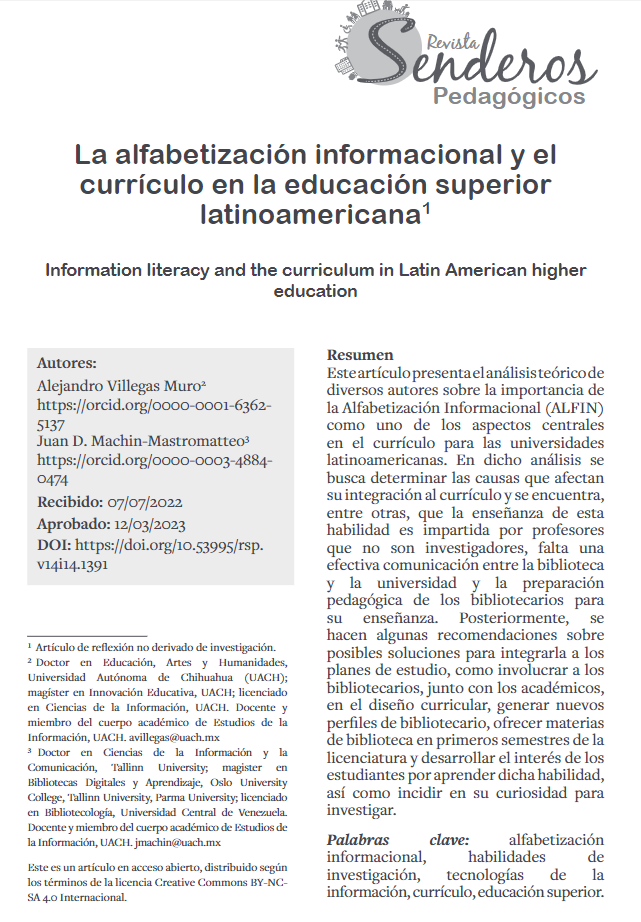
Atendiendo las necesidades que he detectado en cuanto a la formación de editores, particularmente en América Latina, inicio un nuevo proyecto editorial con la sección “Escuela de editores”, que aparecerá en cada número de nuestra nueva Revista Estudios de la Información. En esta primera entrega discuto las buenas (y las no tan buenas) razones por las cuales publicar una nueva revista, así como las distintas dificultades sobre la creación de revistas y los primeros pasos para lanzar una nueva revista. Les invito a descargar el texto, disponible en acceso abierto.

Machin-Mastromatteo, J. D. (2023). Así que quieren crear una nueva revista científica, ¿para qué? Revista Estudios de la Información, 1(1), 127-139. https://doi.org/10.54167/rei.v1i1.1285

Revista Estudios de la Información, 1(1)

📣¡Nace una revista!📣 Nos complace informar y compartir con nuestros colegas y especialmente estudiantes de Ciencias de la Información y disciplinas afines, que acabamos de publicar el primer número de la Revista Estudios de la Información 📗🥳🎉Este hito representa la cristalización de muchos esfuerzos y sacrificios. Esperamos sinceramente que la nueva revista sea de utilidad y agrado. ¡Queremos saber sus opiniones! Primer número disponible en el enlace, completamente en acceso abierto y sin ninguna restricción 🎁 https://vocero.uach.mx/index.php/Estudios_Informacion

El artefacto como sistema generador de conocimiento en ambientes científicos de la nanotecnología

Invitamos a revisar nuestra nueva publicación “El artefacto como sistema generador de conocimiento en ambientes científicos de la nanotecnología“, por Heriberto Ramírez-Luján, Javier Tarango y Juan D. Machin-Mastromatteo #filosofía #tecnología #información #conocimiento

Ramírez-Luján, H., Tarango, J., y Machin-Mastromatteo, J. D. (2023). El artefacto como sistema generador de conocimiento en ambientes científicos de la nanotecnología. Scire: Representación y Organización del Conocimiento, 29(1), 51–62. https://doi.org/10.54886/scire.v29i1.4902

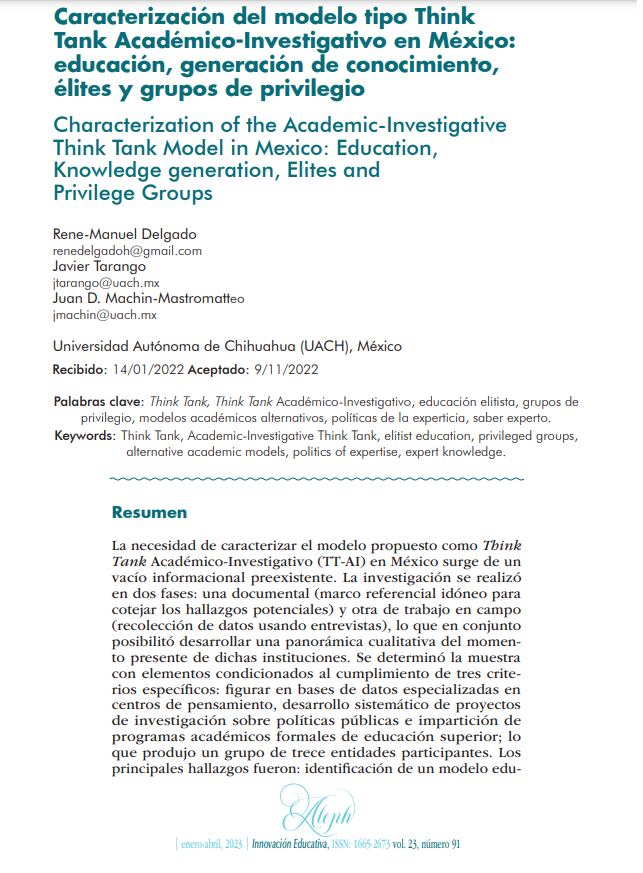
Caracterización del modelo tipo Think Tank Académico-Investigativo en México

Invitamos a revisar nuestra nueva publicación “Caracterización del modelo tipo Think Tank Académico-Investigativo en México: educación, generación de conocimiento, élites y grupos de privilegio“, por Rene-Manuel Delgado, Javier Tarango y Juan D. Machin-Mastromatteo #ThinkTanks

Delgado, R. M., Tarango, J., y Machin-Mastromatteo, J. D. (2023). Caracterización del modelo tipo Think Tank Académico-Investigativo en México: Educación, generación de conocimiento, élites y grupos de privilegio. Innovación Educativa, 23(91), 9-37. https://www.ipn.mx/assets/files/innovacion/docs/Innovacion-Educativa-91/Caracterizacion-del-modelo-tipo-Think.pdf

Benchmarking library, information and education services

Just published the following book chapters

Machin-Mastromatteo, J.D. (2023). Best practices for developing and disseminating audiovisual contents to promote library and information services. En D. Baker, L. Ellis, C. Williams, y C. Wragg (Eds.), Benchmarking library, information and education services (pp. 295-306). Elsevier. https://doi.org/10.1016/B978-0-323-95662-8.00024-2

Tarango, J., Machin-Mastromatteo, J.D., y Cortés-Vera, J. (2023). Information users as active prosumers: perspectives from social marketing and sociocultural value for academic libraries’ benchmarking processes. En D. Baker, L. Ellis, C. Williams, y C. Wragg (Eds.), Benchmarking library, information and education services (pp. 265-279). Elsevier. https://doi.org/10.1016/B978-0-323-95662-8.00001-1

Digital Library Perspectives 38.4

PDF

Digital Library Perspectives’ 38.4 is out, read our editorial, signed by Anna Maria Tammaro and myself, presenting the articles on this issue.

https://doi.org/10.1108/DLP-02-2023-138

PDF

Digital Library Perspectives 38.4

PDF

Digital Library Perspectives’ 38.4 is out, read our editorial, signed by Anna Maria Tammaro and myself, presenting the articles on this issue, including #DigitalLibraries #ResearchSupport #TechnologyAcceptance #InformationLiteracy #blockchain #OpenAccess #collections #GoogleAnalytics and #PeerToPeer

https://doi.org/10.1108/DLP-11-2022-136

PDF

Information and digital literacy initiatives 2

The second special issue I edited for Information Development has been published! Read my editorial, in which I present this issue’s articles and pay a humble homage to Paul Zurkowski, originator of #InformationLiteracy https://doi.org/10.1177/02666669221115554 #SAGE #InformationDevelopment

Digital Library Perspectives 38.3

PDF

Digital Library Perspectives’ 38.3 is out, read our editorial, signed by Anna Maria Tammaro and myself, presenting the articles on this issue, including #DataCuration #metadata #credibility of #SocialMedia #eBooks #Koha #SustainableDevelopment #learning #COVID19 #InformationLiteracy

https://doi.org/10.1108/DLP-08-2022-135

PDF

Higher education students’ achievement emotions and their antecedents in e-learning amid COVID-19 pandemic: A multi-country survey

PDF

Abstract

The outbreak of the COVID-19 pandemic has had a wide range of negative consequences for higher education students. We explored the generalizability of the control-value theory of achievement emotions for e-learning, focusing on their antecedents. We involved 17019 higher education students from 13 countries, who completed an online survey during the first wave of the pandemic. A structural equation model revealed that proximal antecedents (e-learning self-efficacy, computer self-efficacy) mediated the relation between environmental antecedents (cognitive and motivational quality of the task) and positive and negative achievement emotions, with some exceptions. The model was invariant across country, area of study, and gender. The rates of achievement emotions varied according to these same factors. Beyond their theoretical relevance, these findings could be the basis for policy recommendations to support stakeholders in coping with the challenges of e-learning and the current and future sequelae of the pandemic.

https://doi.org/10.1016/j.learninstruc.2022.101629

PDF