Revenge of the Nerds Micro Review

Revenge of the Nerds (Jeff Kanew, 1984). This movie is very good and entertaining and it has aged well. Check out the musical number in DEVO/Michael Jackson style! Maybe nerds have a bit more respect nowadays, or at least some of them have proven to be very successful people. In a broad sense this is one of those American movies were two very different groups (one of them dysfunctional) clash or battle with each other, and the viewer has the chance to side with one of them. You have the Nerds, of the fraternity Lambda Lambda Lambda which are sort of the “ugly ducklings” or anti-heroes of the story and the other are the Pi Delta Pi  and the Alpha Betas which are depicted as the “normal not nerds” kids, for me these are the villains. If you don’t side with the Nerds while watching the movie, then you must have problems.

I’m making this review a bit different by adding the following sort of social commentary. It is really sad to see some things happening in the movie happen today: bullying / cyber bullying. In some learning environments, there is a tacit belief that the stronger or the most apt in sports can and shall dominate other students weaker in these areas. I think I was very lucky that in college I had a very normal and pleasant life, there are no such things as fraternities in the country I studied my Bachelor degree and I think that the fact it was a public university also helps in that because of the high diversity there, these problems don’t happen too often. The previous time I saw that movie must have been like 12 years ago and maybe I didn’t understand it as I see it today. I really hated the characters of the “normals”, I even couldn’t stand them on screen! I already told you it was easy my pass through university, but high school was a different story, there was a certain person who studied almost all the way since primary with me, hated that stupid piece of s+++t. It was the bully of the school and the school even promised several times they would get him out, but they didn’t and no corrective action worked with him. I think now in retrospective that his only presence after some years influenced the environment so everything and everyone were kind of at his service, even girls and teachers. I think this environment did some terrible things to me, as for example I was not very confident in many ways when I was a kid, sucked at sports (except the last two years), my performance just declined with time, I felt depressed some times and well, overall my self confidence was very low and I believe that some of the decisions I took just at the end of high school and at the beginning of college years were affected by this. I think bullies can undermine the lives and hopes of other students who don’t decide to confront them, and also for the student who just go with it. I sadly just confronted him a couple of times, if I were to live again those years I’m sure I would kick his sorry ass very badly. But now I’m proud to say that I overcame most of my insecurities and issues created by high school’s fault. Like Lewis in the movie I decided to take a stand and I even recovered the best girl from the evil clutches of the bullies. And yes, I’m a Nerd!

Venezuela bans videogames

As a kid there were two things that encouraged me to explore new worlds and learn English: rock music and videogames. Some days ago in Venezuela, my place of birth, they started to enforce a law to practically ban videogames., with fines from 30.000 to 60.000 US$ and prison time from 3 to 5 years for those who import, sell, distribute and (use?) videogames. That is very sad for me, as Venezuelan and as a gamer. I feel they are closing a way for kids to learn English with games to have more and better opportunities than the ones who don’t develop language skills (it is important to note that before the current generation of game consoles, which are multilingual, we had the same North American releases, in English). The major driving force behind the law is to protect children from violent games, a thing in itself very plausible, but is a total ban we are talking about, ignoring any age rating system that exist or the rights of adults to enjoy these products as well.

The law’s name is Law for the Banning of Videos and War Toys. It is no secret that there’s a huge problem of crime and violence in the country, this is one of the premises supporting the law, as the congress state that “there are scientific studies that prove there is a notorious influence on the future citizen’s conduct and the activities they do in the games”. But how about the incendiary speeches of most of the politicians in the country? And the possession of guns among the civil population and the shootouts in the slums? How about the continuous acquisition of guns, weapons, planes, submarines, etc? The almost declarations of war with neighboring countries?

The politicians at the congress indicate that this law “is not going to solve the problem of the violence, but it opens a space, a positive scenario for the discussion in different areas, nationally and internationally”. These statements only show the shortsighted criteria used by the politicians to make this law, how do you open a space for discussion with a total ban? It’s like in the United States with the prohibition, you only encourage the creation of illegal channels and businesses which is way worse as history has proven. As a gamer, I had to cope up with the problems of distribution of games in Venezuela, there are no GameStops, so there were independent importers who could charge you up to 140 US$ for a game and about 900 for a console (these were numbers I found out between December-February when I went to Venezuela), now with all videogames related economy being illegal, how much should be the price for an original game?

As many of the country’s laws intended to censor something, the solution is to ban, to punish or close,  like they did with the radio stations they closed, with the television channel they had the luxury to close two times, can one be critical? No, the government won’t even try to find a middle ground, to cite a Venezuelan politician: we have a clash of classes.

Some could say that the law is not a total ban, but it’s so vague, so we can be talking about that stomping on goombas or racing a kart while throwing turtle shells is violent and war-like.

So it’s Game Over and no Continues left, it’s a sad, sad day…

How checking an online library catalog can be a geeky travel to the past

The National Library of Venezuela offers one of the most unique experiences in online library catalogs. To be able to check the catalog, you need to go first on a part of their website where you have the instructions on how to use it, only in spanish for now, but take my word on them.

First you will need a software to uncompress files, like Winizip or Winrar, then you have to download a “3270 emulator” for Windows, sorry, no Linux or Mac OS support for now, but works on Vista and 7, so that alone it’s pretty cool. As for this 3270 emulator, Wikipedia says it’s “a computer program that duplicates the functions of an IBM 3270 (manufactured c.a. 1972) mainframe computer terminal on a PC or similar microcomputer.”

So, following the installation of the emulator, configure the IP to 200.90.17.68 and you will enter the automation suite ND-NOTIS. Again, taken from Wikipedia: “ND-NOTIS was a tightly integrated yet modular office automation suite by Norsk Data introduced in the early 80s, running on the SINTRAN III platform on both ND-100 and ND-500 architectures.”
Now there’s no more mouse input for you, so you have to login and input commands using only the keyboard: you press “b”, then “Enter”, then “Tab”, you put in the username “OPERATOR” and password “OP3RAT0R” (pretty sneaky, huh?), then “Enter”, “F10” and write in caps the word “LUIN” and… VOILA!

Cannibalize Yourself Forever!

image002

Between 2002 and 2005 I managed to bring together a group of students from various schools of the Central University of Venezuela in a rather heterogeneous group, but with the common interest of writing literature. The first years we had no visible name or voice, but it was in 2005 that we really made university hear about ourselves, we found we could register the group as a group of university extension, which we did. With this request we could request the use of the auditoriums and halls of the Faculty of Humanities, pay for a few hours. We did some presentations on these places, also in the open areas of the University, in the classrooms we made our literary meetings and on the Internet we found a way to communicate and disseminate our writings. 2005 was our golden age, but  at the end of that year, the group disappears and today in 2009 the site where the magazine  was will be closed as Yahoo Geocities service changes and becomes a paid service, so I post t his invaluable material on my blog to rest and inspire. Let this be a reminder of something we accomplished and to be as well a tribute to the  Canibalización Aleatoria (Random Cannibalization Group) and all the poets who were part of it. Sometimes I feel nostalgia for the time we spent together, all that we did and also the material produced, its quality fills me with pride, although I would like the group to continue to exist, but I know time and distance are factors difficult to overcome. Without further ado I present the 5 numbers of the Venezuelan Experimental Literary Magazine Canibalízate. Enjoy them. (Only in Spanish, sorry).

No. 1

No. 2

No. 3

No. 4

No. 5

The Beatles 2009 remasters

beatles_stereo_box_set

OK people! I was really expecting for these to get released since a long time ago, I grew up listening to the Beatles and I have almost all their albums in compact disc. The Beatles as opposed to other major British artists like Pink Floyd, David Bowie or The Rolling Stones, have not had a really digital remaster release of their career, it was a shame really, that all we had as standard editions were the first 1987 masters, the first and only release of their music on CD if we don’t count the Anthologies, Capitol Years Box, and the most recent Love. After Love was released with this very fresh sound everybody was expecting new remasters for the Fab Four albums. I myself had to buy the album Love via an Internet store we have in Venezuela and pay more than 5 times its price because Venezuelan music stores went insane before this and they were always crazy about pricing The Beatles music, the album Love was priced about 15 times its normal price (about $100). But the rants against overpricing in my country are material for another post.
beatles2This music is great I have really fond memories of listening to The Beatles throughout my life, great moments enjoying with my friends especially the tracks A Day in the Life form Sgt Pepper Lonely Hearts Club Band and Strawberry Fields Forever form Magical Mystery Tour. It’s funny that I even thought of a classifying system for people who listen to the Beatles, in a broad sense you have the people who likes the first part of their career from (Please Please Me to Help) and the people who likes the second part (from Help to Let it Be), they have two very differentiated stages, you know, when they started “experimenting” when I really think the music turned a lot more interesting, when I started listening to them I really liked the first stage of their career, but from some years ago I prefer the second stage by far. So my theory was like: the first stage is more likely to be liked by children and people in their 60s or more and the other part to people below 60s, of course, this is no proven truth, it’s just silly speculation. I also have my friends who don’t like The Beatles at all and prefer The Rolling Stones over them…

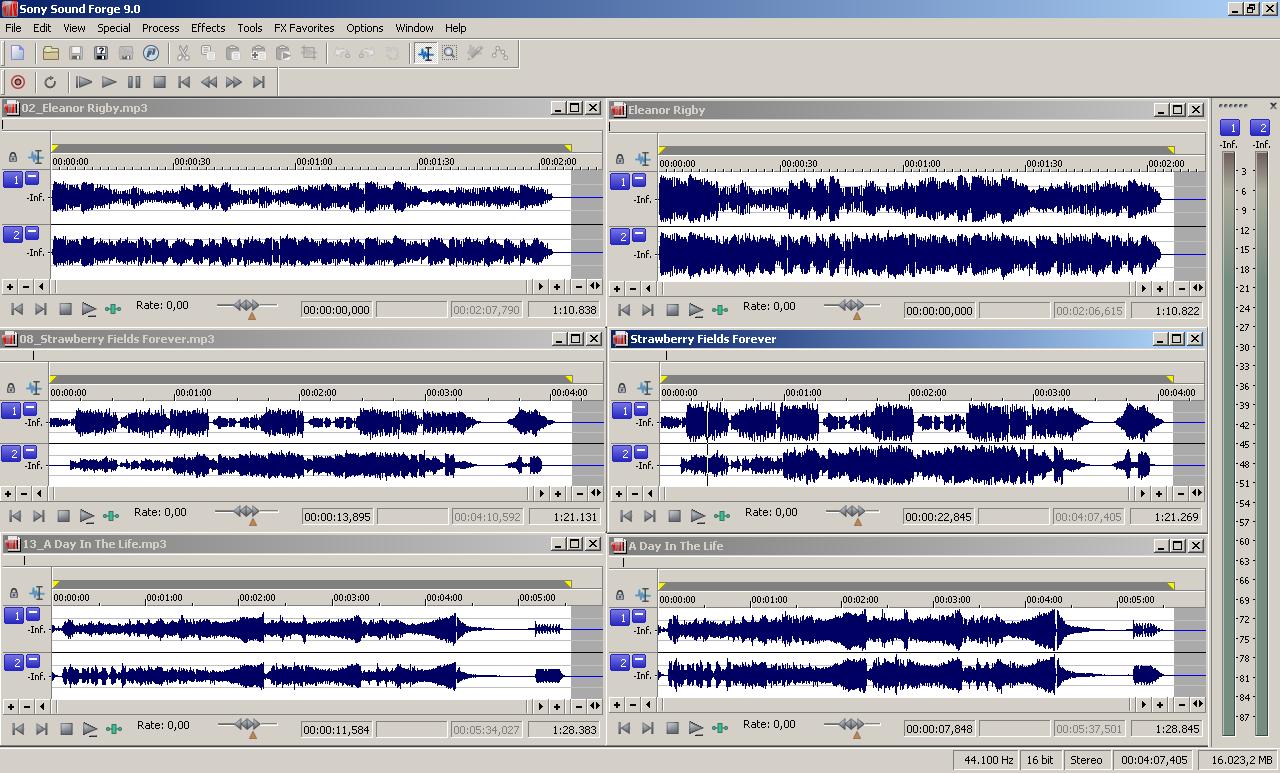
beatles_-_abbey_roadAbout this 2009 remasters themselves, I haven’t listened to everything there is yet as I wait to buy it all later this year as a boxset, but I can tell you that so far I heard, the music sounds louder, and maybe sounds a bit brighter. Maybe, the expectation and anticipation was too high that I was expecting something more impressive, but don’t get me wrong, I love the music and must probably will buy the full boxset of the remasters, I also have to compare the two editions with more equipment, I have heard just a couple of albums with my laptop with its own speakers (Altec Lansing) and the iphone default headphones using Winamp. I would like to share with you an experiment I made putting 3 tracks from both remasters in Soundforge (click to enlarge), we can see that the soundwaves are indeed different, but its only a question of volume that’s changed? Or there’s more to it. Please comment your experience with the 2009 remasters.

beatles

On the problems of liveblogging events

I just finished reading my bulk of unread google reader items, well, I have to actually mark as read the subscriptions which always grow too large to handle, and I found that my colleague aubreymcfato has put on one of his reviews of the ECDL 2009, conference that we attended together, a small note from Joho the Blog by David Weinberger that describes really good the experience and the feel of being liveblogging about events we are in. This is really valid for my first post on ECDL and the upcoming ones on the conference or of the same nature, that is, notes taken while I’m hearing some presentation or something of the sorts. I’m sorry for any lack of accuracy. David Weinberger’s disclaimer is the following:

“NOTE: Live-blogging. Getting things wrong. Missing points. Omitting key information. Introducing artificial choppiness. Over-emphasizing small matters. Paraphrasing badly. Not running a spellpchecker. Mangling other people’s ideas and words. Posted without re-reading. You are warned, people.”

ECDL 2009

Picture 074

Hello again!

I’m lucky to be right now in Corfu, Greece where I’m attending with my fellow DILL colleagues the 13th European Conference in Digital Libraries. More or less as part of the third semester of the DILL master and thanks to our Professore Vittore Casarosa we have been attending this wonderful, high profile conference in the field of Digital Libraries. As you may or may not have seen, I’m tweeting about the conference, but to complete my own coverage on it I decided to post some things in the blog. So, in this post I will present an outline of what was the first day of conference (09-28-09). Enjoy.

Picture 043

Keynote: Digital Libraries as Phenotypes for Digital Societies

by Gary Marchionini

This 13th edition of the European Conference on Digital Libraries (ECDL) started with “a bang”, with a very interesting keynote by Gary Machionini, titled Digital Libraries as Phenotypes for Digital Societies. Marchionini started with the statement that Digital Libraries gives us a lens on what we are becoming in the digital age, he then defined some characteristics of the digital societies, such as the following ones:

They are determined by topic or interest of individuals or communities, rather than by the geography, because ICTs bridges people regardless of their location. Of course, digital societies are dependant on technologies and electronic infrastructure. They are driven by weak ties, this can be seen in social networks such as facebook where one “collects” contacts or friends that you don’t actually have to know personally, the acquaintance process is very different than in the “real world society”. Individuals in this digital society are also extremely diverse, if the location makes little difference, people interacting in a network come from different places and that makes them different, different culture, religion, behavior, etc. Digital societies grow fast, we can say they are viral, but at the same time they can lose members at the same speed, they are not so sustainable, as the fidelity of the members it’s different from person to person. These societies of course are based on our “real world society” and interact with traditional institutions.

Next, Professor Marchionini defined the Phenotype of Libraries:

  • They are social organisms.
  • Have foundational and policies that reflects their institutional genetics.
  • The influence of the environment affects their collections and services.
  • They reflect the social organizations that support them.

Digital Libraries are active workspaces, it’s not enough to set up collections multimedia streams, systems exhibit behavior, this means there’s a memory on them, they are dynamic and interactive, these interactions are kept as a general history (like a website history on an Internet browser), and users interactions should be considered part of a Digital Library collection, these interactions are made by their annotations, comments, news feeds, tags, crowd sourcing, and as a collection, these contributions must be managed.

Key challenges

  • Content and context: selection management.
  • Preservation: What’s worth preserving? What context to include? Who decides? Who pays? How much? Storage models: replication (copy) migration (change of format, impractical), emulation. Storage policies (authority, cost) Storage challenges: space vs price vs reliability.
  • The new Alexandria: distributed content and stakeholder, self organizing content, human-machine hybrid, new kinds of trust management.
  • Managing participation and services: a symbiotic human-machine relation
  • Content Genetics: born digital documents, hybrids from traditional libraries.

DL Collection models Born digital variants:

  • Curated by expertise (Perseus)
  • Curated by expertise opportunity (Open Video)
  • User contributed without curation (ibiblio)
  • User contributed with community curation (wikipedia, youtube)
  • Computed (citeseer, technorati, google?)

Picture 011judamasmas’ comment: this was a really amazing presentation, I liked it a lot. I also think is important to take into account that the users of the library could create valuable content and that this same content can be part of our actual collections. I think we have some lessons to learn and some features to import from the worlds of open access and social networks, because our way of building collections may not be very attractive by itself and funding is getting more an more difficult, just to cite two reasons.

After Professor Marchionini finished his keynote presentation, we went for a coffee break in this really nice and beautiful Hotel Corfu Palace. After the break it was decision time, because they were two sessions in parallel: one on interaction and the other one in knowledge organization, I decided to go to the interaction session. You can find information on the other one in the tweets of my colleague Andrea in twitter (aubreymcfato) or in his blog questoblognonesiste.

Session 2A: Interaction

Hear it: Enhancing Rapid Document Browsing with Sound Cues

by Parisa Eslambochilar, George Buchanan and Fernando Loizides

It is interesting that the presented started stressing the point that in Digital Libraries interfaces are silent, like in “real world libraries”, but has it to be like this?

Document readers have attempted to help users locate new or unknown information and there has been success with providing visual target cues.

Some of their findings:

Audio seems to permit faster movement and higher zoom levels, it could be improved by better timing the cues, allowing for delays.

Future works:

Evaluate anticipatory cue timing, reconsider performance with improved cue, compare against tactic cues.

judamasmas’ comment: We can think that this could be a good multidisciplinary work because it could involve librarians (digitals or no!), experts in sound media (recording, storing and playing), and even psychologists.

Creating Visualizations for Digital Document Indexing

by Jeniffer Pearson, George Buchanan and Harold Thimbleby

Goals:

Combine elements of digital and print indexing search, understand the properties of search in digital documents

They created a new interface, the digital index viewer: builds traditional index from digital document, with number of occurrences on which pages for different words.

Different presentations of the digital index viewer:

  • Color Tag Clouds: red indicate many occurrences (as it represent hot temperature) and blue indicate few occurrences of the term (as it represent cold temperature)
  • Tag clouds: the bigger the more occurrences
  • Graph: the bigger the more occurrences

User performance on speed of search: traditional index < color tag cloud < graph

judamasmas’ comment: They took the indexes, a very traditional idea that’s present from a long time ago in printed books, and applied them to digital documents, it is interesting that it is an application that generates an index on a digital document and takes some elements we see in web 2.0 like the tag clouds to add more depth to it and to make it more visual.

Document Word Clouds: Visualising Web Documents as Tag Clouds to Aid Users in Relevance Decisions

by Thomas Gottron

Term importance not visible for users, users scan documents on the web, if they are attractive, the user decides to read it or not. Transfer tag cloud idea to important words in documents.

Term importance is calculated by a formula which deals with term frequency, document frequency and corpus size.

Prototype system turn web documents in clouds to help relevance decisions and it’s independent of the query.

judamasmas’ comment: So, one problem with the information overload we have (it’s only getting worse and worse!) is that we struggle with the problem of what item to read first, or what to download. For example google ranks results in its own special way, I’m not saying it’s bad or wrong, it could be good for one occasion, but totally wrong for other ones. This work proposes a system that harvests important terms present in a digital document to help the reader view what is it about in a tag cloud fashion. Also an interesting use of Web 2.0 widgets for visual aid.

Picture 025Special Session on Services

Annotation Search: The FAST Way

by Nicola Ferro

Mix content of annotation with metadata, to add richness to improve search, including author of the annotation, language, types (image, text)

judamasmas’ comment: annotation has been a very antique technique that some readers and scholars have used to go back to the books or documents they have studied for a quick look at the parts they like and where they made some notes (funny thing is that my librarian side tells me not to annotate any book for preservation reasons), it is, indeed really good if we can have good annotation tools in digital documents, first because it doesn’t change the aspect actual document and also because we can have a workflow cycle of contributors or fellow researching studying the same documents that we are, creating a series of comments that we can retrieve by type, author, date and so on.

wikiSearch: From Access to Use

by Elaine Toms, Lori McCay-Peet and Tayze Mackenzie

Design an interface for search, to maximize visibility, minimize search time, not overload user’s working memory, provide structured dispaying, provide only relevant information, putting user’s preferred items on interface

Characteristics: Ease, speed, efficiency, navigation, task focus and organization.

Google-like interface was preferred because the new wikisearch was so new, google seemed more simple.

Limitations:

Was lab rat research, very restricted tabs and access to web in general, built tool eliminated labyrinths of pages selected, better integrate with browser and work task.

Dark City Micro Review

Originally published on judamasmas s-tumblrs

Dark City (Alex Proyas, 1998) must be one of the most underrated films of the 90’s, beign almost a failure at box office performance, it has earned with the passing of the years high acclamation from movie critics (strangely perhaps? like Roger Ebert) and audiences, becoming a cult classic. This movie presents you with a simulated reality story, it wasn’t a new way of storytelling at that time, but for further enjoyment of this movie you have to consider that it was released one year before The Matrix. In this fictional world a race of aliens called simply the Strangers have enslaved humanity without them to realize what’s happening. I said enslaved? it’s better to say that they are having a huge experiment with humans in order to find a solution and prevent their annihilation. The experiments consists in that they are changing the shape of the city every night, or maybe to say night is not so appropriate because there’s no sun (that’s why the movie it’s called dark city), so they change the shape of the city once in a while, replace the people’s memories and swap their location on the city. But the moving force of the movie, speaking in other movie’s language starts when an anomaly or an unexpected value affects the equation. John Murdock is the main character in the movie and he’s a human with the same psychokinetic powers as the Strangers, he’s lost his memories and has been framed with murder by the Strangers. So the movie it’s about him trying to make sense on what’s happening while escaping the firm grip of the Strangers. So, the rating, I give this movie a perfect score, it’s actually one of my favorite movies ever. The performances are excellent, Rufus Sewell makes a good main character but not amazing, but we have the strange scientific in Kiefer Sutherland, the police detective in William Hurt and OH MY GOD!! my love Jennifer Connelly is the wife of the protagonist and she sings! (actually only sings on the Director’s Cut), the Strangers look very evil and disturbing so they are great bad guys. On the effects side, special mention on the morphing sequences of the city. Music is very good and it always emphazises the menace of the Strangers and keeps you on your toes. The story, my favorite part, is simply amazing, it’s based on the always amazing argument, y’know? maybe nothing is real…

Bride of the Monster Micro Review

Published originally on judamasmas s-tumblrs

Bride of the Monster (Ed Wood, 1955) leaves you with the “what the heck I just watched” sensation. Widely regarded as the worst filmmaker of all time, and this movie, originally titled Bride of the Atom was his first horror movie. Having the actor Béla Lugosi in his last years wasn’t at all a recipe for a successful movie. But I’ve seen movies with him that are worse than this one. Béla is your stereotypical mad scientist who has the help of his minion Lobo, played by wrestler Tor Johnson, and has as goal the creation of supermen. But his plans are screwed after kidnapping a girl, event which is simply the downfall of B-movie villains. The performances are not so bad, but there’s one scene with a speech of Béla which is just wonderful acting. What is really bad in this movie is the integration of stock footage with proper footage of the movie, a known flaw in Ed Wood’s movies, and also the most fake and funny monster ever, the octopus, the actors had to fake they were attacked by it, and move its tentacles because that monster didn’t even move! I only recommend this movie to B-movies OR classic horror movies OR Béla Lugosi’s fans; if you don’t watch it, you’re only missing one wonderful Béla Lugosi monologue…

Mars Attacks Micro Review

Published originally on judamasmas s-tumblrs

Finished watching Mars Attacks (Tim Burton, 1996) after a lot of years, 10 out of ten, the final solution to annihiliate the aliens is as stupid as in Independence Day, but think about it, ID is “serious” american cinema and MA is clearly an homage to B-movies. Anyway if we are attacked by superior aliens, they wouldn’t run Windows to be affected by a computer virus. So I find the tactic of MA more plausible. Music is great, Danny Elfman, of course; the cast is awesome, you can’t go wrong with Jack Nicholson; the effects are a mix so the unity is not completely achieved but the aestetic approach is superb, so 50’s it could be black and white. Special mention to the American national anthem played by mariachis, just amazing!